Monday, June 1, 2020

Enmei Juku Kannon Gyo


Since the start of my training with Ajari Tanaka in the late 1980's we practiced the recitation of a very short sutra called the "Enmei Juku Kannon Gyo" every time Ajari conducted group practice at the original Mandala Center in Lincoln Vermont.  And as the time went by the duration and intensity of these recitations increased as Ajari lead this practice in a similar way he conducted mantra practice.

Later, in the mid-nineties Ajari Tanaka started to give as gifts copies of the Enmei Juku Kannon Gyo, the ten line, long life Avalokitesvara Sutra.  In the late 1990's, some of us who attended Ajari's "summer camp", a ten day intensive were gifted signed and sealed copies of this sutra.

In 1999 when Ajari Tanaka informed his small group of students that our Mandala Center would close and he would need to move back to Japan, an even smaller group helped him prepare for the move.  We gathered up everything Ajari needed to take or be shipped back to Japan.  We arranged for a storage unit for things to stay behind.  But most importantly he gifted us the treasure of Shingon.  Shrine furniture, shrine objects, beautiful mandala, vajra and bell, meditation cushions, books and untold other treasures.  Ajari's generosity and trust was overwhelming.  He acted as if the few of us who'd trained with him could transplant Shingon first in Vermont and then entire U.S. 

In all the many things Ajari left with us we found other treasures we were unaware of.  During his time in Vermont Ajari had a shodo studio in his home.  When we cleaned it out we found stacks of copies of the Enmei Juku Kannon Gyo.  Like, mountains of them.  It was then obvious that Ajari had been using this sutra as an Oshakyo practice for a long time.  Some were just the sutra.  Others were signed.  Others were signed and sealed with his personal seal.  And a spare few were signed and sealed with both his personal seal and the seal of the Mandala Center.  And if that wasn't enough, we found a sizable collection of the same sutra brushed by Yukiko-san, Mrs. Tanaka.  And they were all beautiful.


In the years ahead, Ajari would visit Vermont each autumn.  In the early 2000's it was our custom to hold a retreat during his visit at the South Starksboro Friends Meeting House.  Each day of the retreat was filled with practice, as well as a Shomyo and Shodo lessons.  Over the years these Shodo lessons ranged over a wide variety of selections - mantra, specific characters, Japanese folk advice about why we should love our parents.  All kinds of stuff.  None of us were very good at Shodo, but we dutifully tried.


During three of those retreats, Ajari dedicated our Shodo lessons to teaching us the entire Enmei Juku Kannon Gyo.  Though relatively short, the piece includes fifty characters.  Fortunately some repeat.  But it was a big undertaking.  Needless to say, none of use walked away from the retreat feeling as if we could confidently practice this on our own, even those of us that were there all three times.

But we did walk away with a deeper understanding of this little sutra, as Ajari spent a fair amount of time explaining the different kanji and their meaning.  It was really a unique experience, one in which Ajari's teaching was directly transmitted through the medium of Shodo.

Sadly, I don't think the practice has stuck much with Ajari's students.  I have labored over the years, making a number of specific efforts to learn, memorize and practice this Oshakyo, only to stop and quickly forget what I had worked to absorb.  One year on a beach vacation I practiced by scratching the characters in the wet sad at low tide.  Other times I used a mechanical pencil to try and memorize the stroke order and proper shape of the characters without the complexity added by a brush.


Now, during the current coronavirus pandemic, I have found myself gravitating back to this old practice.  I started slowly, using a sharpie, practicing one line at a time, trying to knock the rust off.  Pleasantly, the memory of the characters, the stroke order, the alignment wasn't to far below the surface.  With in a few weeks time I was back to completing the whole sutra with its title in short order.  I guess the old effort was still in there somewhere.

The next step is to put away the sharpie and get out the brush.

I will always be grateful for all the wonderful teachings and practices Ajari has shared over the years.  But I have to say the Oshakyo of the Enmei Juku Kannon Gyo stands out.  Among all our practices, it represents a very personal expression of Ajari Tanaka's dharma.  It reflects something very close to his essential, core message...


Sunday, March 29, 2020

Thoughts and reflections shared with our sangha amid the pandemic...


Hey mandala,

With things getting more and more constrained, my attention reflexively turns to my experiences with Ajari Tanaka and all the things that he has taught us over the years.

When I first met Ajari he was doing an intensive recitation of the heat sutra.  He has said more than once that he chanted it a million times.  By my math that would take almost four years of uninterrupted practice.  Other times he told me he did it for three hours a day.  More recently, we've all experienced him producing copy after copy of the heart sutra as part of his Oshakyo (sutra copying) practice during his visits to Vermont.  When I visited him in Japan (2008), he did the same each morning, brushing three or four copies before we had breakfast.  I know Ajari has been very generous with his heart sutra copying practice and I hope you all have at least one copy in your personal collection.  It makes a wonderful object of contemplation.

But back to the main point...

Being a little stuck at home and thinking about Ajari's teachings, I've finally started to teach myself to brush the heart sutra.  To begin, I'm working on these opening phrases:

Kan ji zai bo sa
gyo jin
ha nya ha ra mi ta ji

Our text translates this as:

When the bodhisattva Avalokitesvara was practicing profound transcendental wisdom...

During my struggle to find the correct characters, the proper stroke orders and the meaning for this opening phrase I was struck by the terms "gyo jin".

"Gyo" means "to do" and "jin" means "deeply"

"Do deeply".  Just stop on that for a brief moment...

The phrase is simply saying that Avaloketesvara was deeply practicing perfect wisdom.  He was just really, really practicing.  I'm pretty sure that's exactly what Ajari has encouraged us to do all these many years.

In this chaotic time, I hope all the training you've already (deeply) done has made your practice a source of strength and stability, a touchstone that can nourish and revitalize no matter what's going on.


Take good care and I hope to see you all on the other side,

jim

Recently a student asked...

Recently a long time student of Ajari Tanaka explained that he had been recently asked by a colleague, "what is the purpose of chanting mantra?".  Further noting that they had no ready answer for that simple question, he asked me if I'd weigh in.  This is what came of that discussion:

So let's start from the ground up....

First when we chant a mantra, especially in the style that Ajari has trained us in, the first thing that one might notice is our normal stream of conceptual thought is interrupted and replaced by the mantra.  The incessant and often undisciplined/unproductive thought-stream is abruptly abandoned and replaced with neutral sound and vibration.  This might be understood as a rudimentary form of meditation in which we first experience our mind without its typical thought habits.  As this progresses, we can experience a level of concentration (facilitated by really trying to stay with the mantra during recitation enforced by whoever is leading the practice) that most of us don't regularly experience.  This is called smirti, or the re-collecting of our scattered mind.

Secondly, our style of mantra recitation is physically vigorous.  It requires lots of deep exhalation and then rapid inhalation.  Not only physically invigorating but oxygenates our system in ways that are very different from most of our normal experience and stimulates a mental sharpness we often rely on coffee to achieve.

As we learn more about the symbols of Shingon this naturally marries to the practice, enriching it with a contemplative element.  For example, this is the mantra of Fudo Myo-o, and I know he is a wrathful protector, powerful but kind, an emanation of Mahavairocana, which is none other than the entire phenomena universe, but in a form which leads even the most resistant student.  As we recite the mantra all that understanding is there even if it is not conceptually expressed during the recitation.  Through the mantra practice, we are relating directly to the symbol, with its internal and external import as all these symbols depict awakened qualities that exist within us and those naturally resident in the world around us.  This is now on top of suspending thought and the physical invigoration.  

Next, if we are lucky enough to expand our understanding to the individual mantra's meaning the contemplative/symbolic element expands greatly.  For example, the mantra of Nyoirin Kannon, Om padma cintamani jvala hum, means something like, "O the flaming jewel in the lotus hum".  The wish fulfilling jewel is the awakened mind that solves all desires, the lotus is great compassion and the flame is variously deemed to indicate energy/effort, protective defense of the awakened element and the warmth of kindness/compassion.  So not only is the mantra indicative of the particular honzon, but has a specific meaning and contains profound symbolic content in and of itself.  This is especially interesting when the mantra uses seed syllables (Om, hum, A, Ra, phat) that are multivalent and often elastic in their meaning.  A good example of this is Master Kukai's Meaning of the Syllable HUM, which when read makes it seem that nothing is not meant by the syllable HUM.  Collectively, understanding all this is an form of esoteric knowledge that enhances and deepens both the meaning, associations and significance of the practice.

But, returning to the most basic question, mantra recitation is meditation - full stop.  Its not a warm up to get you in the head space for real meditation.  Rather it is a unique form of meditation, as is sadhana practice, ajikan or sutra recitation which on their face do not seem similar to commonly understood sitting methods.

It is a path to experience your mind as it really is, directly.


In these crazy times its really nice to field these questions from our sangha and then spend time on these topics.  If you took the time to read this, I hope you found it useful.

jim

Sunday, March 1, 2020

A brief look at the Diamond Sutra...


Image result for subhuti

Subhuti, someone might fill innumerable worlds with the seven treasures and give all away in gifts of alms, but if any good man or any good woman awakens the thought of Enlightenment and takes even four lines from this Discourse, reciting, using, receiving, retaining and spreading them abroad and explaining them for the benefit of others, it will be far more meritorious.
(DS, p. 74)

The Diamond Sutra is not strictly a Shingon Sutra.  It is more associated with the Zen tradition.  It does not come close in significance to the Mahavairocana Sutra or the Vajrasekara Sutra, as they are the foundation of Shingon and the basis of it's mandalas.  It is not central like the Rishu-kyo's formative perspective on non-duality.  The Diamond Sutra is not even as essential as the Heart Sutra, which Kobo Daishi Kukai asserted to contain all of the Buddhist teaching, both exoteric and esoteric.

That being said, the Prajna Paramita tradition and literature had an influential effect on both the Madhyamika and Yogachara schools of thought and practice.  Kukai notes these as the sixth and seventh stages of spiritual development (KMW, p. 71-73) and as such, the foundation of the Mahayana.  Additionally, Kukai makes an interesting, albeit passing reference to the Diamond Sutra in his, "The Meaning of Sound, Word and Reality":

In a sutra, therefore it is said: "[The Buddha is he] who speaks what is true and what is real, who tells things as they are, who utters neither deceitful words nor inconsistent words."  These five kinds of speech are call mantra..."
(KMW, p. 241)

These connections to Shingon and the Prajna Paramita's place in the history of the development of Buddhist thought and practice make it worthy of exploration.
____________________________

A review of the basics and background of the Diamond Sutra is beyond the scope of this particular discussion.  But that is not to suggest that it is not relevant or worthy of pursuit.  For a workable starting point please review:

https://en.wikipedia.org/wiki/Diamond_Sutra

Also if one is unfamiliar with the chief disciples of the Buddha, basic information about Subhuti, a major figure in the sutra, can be found at:

https://en.wikipedia.org/wiki/Subh%C5%ABti

This discussion is specifically focused on select, and hopefully essential content within the sutra.
___________________________

As is typical of sutras, the opening begins by setting the scene and detailing those in attendance.  In this sutra, Shakyamuni Buddha has just returned to his place of rest after his morning alms gathering and has taken his meal.  Then he is approached by a senior disciple:

Now in the midst of the assembly was the Venerable Subhuti.  Forthwith he arose, uncovered his right shoulder, knelt upon his right knee, and, respectfully raising his hands with palms joined, addressed the Buddha thus:  World-honored One, it is most precious how mindful the Tathagata is of all the Bodhisattvas, protecting and instructing them so well!  World-honored One, if good men and good women seek the Consummation of Incomparable Enlightenment, by what criteria should they abide and how should they control their thoughts?
(DS, p. 24)

Subhuti's question sets the context for the entire sutra and it is none other than the pursuit of complete awakening.  This questions is what all that follows means to answer.  And in classic style, the Buddha responds:

Very good Subhuti!... Now listen and take my words to heart.
(DS, p. 24)

In the following section the Buddha begins to build his response to Subhuti's essential question:

Subhuti, all Bodhisattva Heroes should discipline their thoughts as follows:  All living creatures of whatever class, born from eggs, from wombs, from moisture, or by transformation, whether with form or without form, whether in a state of thinking or exempt from thought-necessity, or wholly beyond all though realms - all these are caused by Me to attain Unbounded Liberation Nirvana.  Yet when vast, uncountable, immeasurable numbers of beings have thus been liberated, verily no being has been liberated.
(DS, p. 26)

Setting aside the questionable classification of all the types of beings in existence, here the Buddha essentially equates his awakening with a universal awakening of all sentient life.  But then, just as quickly denies it.  The reason for this contradiction quickly follows: 

Why is this, Subhuti?  It is because no Bodhisattva who is a real Bodhisattva cherishes the idea of an ego-entity, a personality, a being, or a separated individuality.
(DS, p. 26)

Here the Buddha teaches that the core mental discipline of the Bodhisattva path is not succumbing to the fallacy of self nature but instead embracing the reality of emptiness, or shunyata.  Here is the sutra's advice on how aspiring bodhisattvas should control their thoughts.  Bodhisattvas are advised not to indulge in the error of the assumed reality of individual self-nature.

Later in the sutra, the Buddha elaborates on this, adding the quality of meditative discipline:

Therefore, Subhuti, all Bodhisattvas, lesser and great, should develop a pure, lucid mind, not depending upon sound, flavor, touch, odour or any quality.  A Bodhisattva should develop a mind which alights upon no thing whatsoever...
(DS, p. 37)

This is how aspiring bodhisattva's should abide.  Aspiring Bodhisattvas should strive to perceive without attachment, and if attachment arises, to recognize that they are necessarily cherishing "the idea of an ego-entity, a personality, a being, or a separated individuality".

This pure lucid mind that alights on no thing whatsoever, can only be developed though meditation.  And that is the core teaching of Ajari Tanaka - to develop a daily discipline of meditation.

The sutra ends with the penultimate statement, it's unambiguous core message.  In this final section, the Buddha explains to Subhuti how the message of this sutra might be shared with others purposefully and with the intended effect - their fully awakening.

In closing, the Buddha says the following:

Thus shall ye think of all this fleeting world:
A star at dawn, a bubble in a stream;
A flash of lightening in a summer cloud,
A flickering lamp, a phantom, and a dream.
(DS, p. 74) 

It is difficult to comment further...  These words feels neither deceitful nor inconsistent.  It rings true and real.  It mirrors things as they are.

In the hope that this is helpful and please enjoy the prajna paramita because if you dig in, there's a lot more.

jim


Bibliography
The Diamond Sutra and the Sutra of Hui Neng, Translated by A.F. Prince and Wong Mou-Lam, Shambhala Publications, 1969.  Abbreviated as "DS".

Kukai: Major Works, Yoshito S. Hakeda, Columbia University Press, 1972.  Abbreviated as "KMW".

Saturday, January 25, 2020

An exploration of Kukai's View of Samaya


Yamasaki Sensei outlines Master Kukai's esoteric, or samaya vows as follows:

"One must never abandon the Dharma, give up the aspiration to enlightenment, be stingy with any of the teachings, or engage in any action that does not benefit sentient beings."
(SJEB, p. 57)

Yamasaki Sensei characterizes this vision of samaya as follows:

"Rather than a code of behavior, these precepts are said to describe the conditions necessary for realization of enlightenment."
(SJEB, p. 57)

Adding more specificity and context, Yamasaki Sensei continues stating:

"...these are called the samaya precepts (samaya-kai). Samaya means equality, vow, removal of obstructions, and awakening, here referring to the absolute equality of body, speech, and mind in Buddha and all living beings. "
(SJEB, p. 57)

In conclusion, Yamasaki Sensei states:

"The esoteric vows therefore embody the fundamental esoteric experience, realization of self as Buddha."
(SJEB, p. 57)


Our own daily practice text contains a recitation and contemplation entitled "Samaya-kai".


"I, a child of Mahavairocana Buddha firmly believe in his vow of great compassion.  I will abide in the pure faith of the non-duality of the Buddha and all living beings.  In order to inherit the legacy of the Buddha’s life of wisdom, I as a Bodhisattva will make a wholehearted effort to help others."

This element includes the recitation of the Samantabhadra mantra:

Om samayas tvam


---------------------------------------------------------------------------------------------------------------
SJEB - Shingon: Japanese Esoteric Buddhism, T. Yamasaki, Shambhala Publications Inc., 1998

Thursday, September 20, 2018

Ajari Tanaka's 2018 Visit Retrospective...

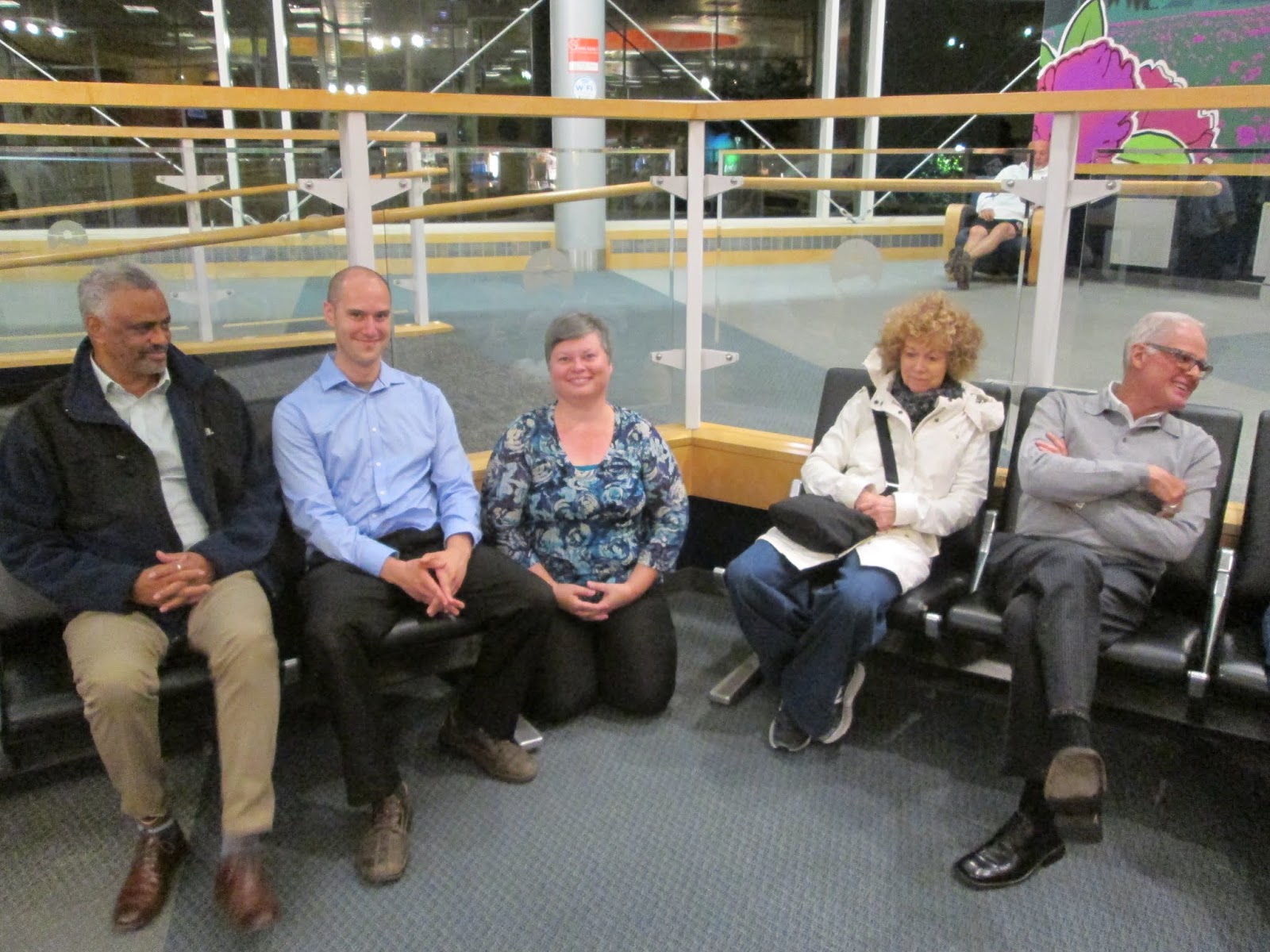
On what seems like yesterday, a small group of Mandala Vermont students gathered to welcome Ajari Tanaka at the Burlington Airport.
And right on schedule, he arrived and his annual visit started.
And very soon thereafter, he was safe and comfortable in his host's home.

On the mornings of Monday and Tuesday Ajari Tanaka oversaw the review of our Gumonji-ho text that we had been working on translating into English for the past three years.
On Wednesday, Thursday and Friday mornings he turned his attention to the Dhama Name Ceremony scheduled for Friday evening.

And in the evenings of Monday through Thursday, Ajari Tanaka led meditations at our Burlington Dojo for small but very grateful group of local students and one intrepid visitor.
And on Friday night five students who have made a strong connection to Ajari Tanaka and the Mandala Vermont sangha received their dharma names. 
And now the fruition of this year's visit began... 
Over the next two days, with Ajari Tanaka presiding we transmitted the Gumonji-ho to the authorized students in the sangha. At the risk of being melodramatic, it was historic for our sangha and also Buddhism in the West.
And before long, our practice and study time of the Gumonji-ho was complete. Seventeen Mandala Vermont students were authorized and trained to practice the same practice that Shingon's founder, Kobo Daishi Kukai used to discover his own enlightenment.
The only thing left was some celebration.
And then a day of relaxation, souvenir shopping and fun in Burlington.
But then the time abruptly came.
And we had to say good-bye for another year...


Monday, September 17, 2018

The last dinner together...Tonight is

Tonight is Ajari Tanaka's last night in Vermont. So, to mark the occasion, a group of us went with him out to a Burlington favorite. It's been a great visit, can't believe its already coming to a close.

Sunday, September 16, 2018

The Class of 2018...

Participants in Mandala Vermont's first transmission of the Gumonji-ho.

We did it...

Today we completed our first transmission of the Gumonji-ho in our sangha.
Wow...

Ajari Tanaka 2018


Friday, September 14, 2018

Dharma Names, 2018...

Tonight Ajari Tanaka gave Dharma Names to five sangha members. The names came from the "Kujo Shakujo", a short sutra used during fire ceremonies (goma) at Tanakahata Fudo, Ajari Tanaka's first training temple in Hino City.

These dharma name recipients received a gift from our sangha of a Shingon rosary that Ajari brought with him from Japan.

It was a pretty happy night.

Ajari Tanaka surrounded by the names he selected for our Dharma Name Event.

Preparations...

Ajari Tanaka practicing Oshakyo after completing the artwork for our Dharma Name Ceremony.

Wednesday, September 12, 2018

Day #3


Finished the edits to the Gumonji-ho this morning and later on in the evening Ajari Tanaka lead a group of eight of us in recitation practice of the Kannon-gyo. After he spoke at length on a number of subjects.

Monday, September 10, 2018

Ajari Tanaka's 2018 Vermont Visit, Day #2 - evening edition


This evening nine sangha members gathered for our first practice session with Ajari Tanaka. These intimate gatherings are so wonderful as we all get to have a very personal experience of our teacher.


And the good news is we have them scheduled every evening this week through this Thursday...

Ajari Tanaka's 2018 Vermont Visit, Day #2

Spent the morning with Ajari Tanaka reviewing our draft of the Gumonji-ho. Plowed through way more that I thought we would and it verified that all the earlier work was fruitful.

Tomorrow we will continue and, if luck stays with us, we will complete the review and be ready to print the text.

It will be a real milestone for Mandala Vermont. This is our first true translation project. We started with the original Japanese text and now, after three years of work we have what appears to be a quality English language version of the Gumonji-ho.

My gratitude to Ajari Tanaka for his patient help with this project and for the multi-lingual sangha member who did the fundamental, instrumental translation work cannot be captured in words...

I'm so happy our sangha will now be able to practice this same sadhana that Master Kukai used to discover his own enlightenment.

Saturday, September 8, 2018

The traveler has returned...

A small group of sangha folks stayed up way past their bedtimes to meet Ajari at the airport. Strangely enough another sangha member happened to be on the same flight from Chicago that brought Ajari Tanaka to Burlington.  Hilarious.


So he's here again. He's really here...


We all couldn't be happier that he arrived safely.  And better yet he looks great and seemed very energetic after his long flight. Now the best part starts, all the things we have scheduled for his visit.


Simply fantastic...


So it begins again...

"Yume", Dream by Ajari Jomyo Tanaka
Ajari Tanaka arrives here in Vermont tonight at just a few minutes after 9:00 PM. He will be with us for ten days and this year is devoted to finalizing a project we have been working on for three years.

Ajari Tanaka's original, Japanese language version of the Gumonji-ho

Three years ago a student of Ajari's with considerable skill in Chinese asked Ajari if she may try to translate his version of the Gumonji-ho.  Ajari agreed and the process began. After a year we had the first rough draft. We reviewed this with Ajari Tanaka and he helped us make many improvements. We spent the next year improving many of the texts elements and crafting it into a form suitable for practice. Last year we did another round of reviews with Ajari. This really helped us refine the text and produce what we believe is very close to the final version.

Mandala Vermont's English Language Version of the Gumonji-ho

Next week we will again spend a significant amount of time with Ajari Tanaka finalizing this text.  And our project will come to fruition next weekend, September 15 & 16, during which time this practice will be introduced to our sangha for the first time.  This has long been an aspiration of many of Ajari's students and we are very happy to soon be able to practice the same sadhana that Master Kukai used to gain his enlightenment.

We are very lucky indeed...

"TRAH", the seed syllable of Kokuzo Bodhisattva

Friday, May 11, 2018

HUM #4: The Ultimate Meanings of the Syllable "U"


"...no existence is found to be in want [of Buddhahood] is the ultimate meaning of the letter U."
(Hakeda, p. 250)

This is Kukai's opening statement on the meaning of the syllable U, and by it he leaves little to doubt. Kukai's view and core teaching is the non-duality of not only buddhahood and sentient beings, but the entire phenomenal world. Using the logic of causality, this non-duality naturally expands to a view of all phenomena as interrelated and unified despite the apparent diversity.

In the following passage, Kukai reinforces this view:

"Through the eyes of the Buddha, the truth can be perceived that both the Buddhas and all sentient beings are abiding on the same ground of deliverance. There is no distinction between this or that; they are non-dual and equal."
(Hakeda, p. 252)

And he completes this progression, with this statement:

"...they are, like a perfect circle, perfect in themselves [as to their intrinsic nature]."
(Hakeda, p. 252)

But along side this, Kukai also begins to make a distinction. He directly addresses the gulf between enlightened and ordinary existence by quite clearly speaks to suffering and the entrapment of samsara.

"Those who are born in the triple world,
Or suffering beings, fallen in the Six Transmigratory Paths,
Appear here and disappear there in samsara.
Without stopping even for a moment.
Sacrificing substance for shadow,
They live in pursuit of illusions."
(Hakeda, p. 253)

So in parallel with the view of universal inherent buddhahood, Kukai speaks to the reality of suffering. But he also indicates the limitation of the states associated with suffering.

"Such transient states of their existence
May appear to be devastating and injurious;
Yet their intrinsic nature thereby is unaffected."
(Hakeda, p. 253)

Drawing a clear distinction between intrinsic nature (buddhahood) and manifestation (existence marked by suffering), Kukai comes very near his teaching on "ri" or "principle" that is the central attribute of the Taizo-kai mandala. "Ri" stands for the inherent and unmanifest buddhahood in existence. Ri is juxtaposed with "chi" or wisdom, which is the manifest buddhahood represented in the Kongo-kai mandala.

Kukai expands on this theme in the following verse on samsaric existence:

"From the beginningless beginning
They have been living in the space of Mind.
Yet being covered by their illusions
And being entangled by their defilements,
They are unmanifest like a mirror inside a box..."
(Hakeda, p. 253)

Wow. So Kukai indicates that are obscurations and karmic hindrances are not capable of damaging our intrinsic enlightened nature, they are capable of masking them to the point they are unknowable.

Really, wow...

Bringing this line of thinking full circle, Kukai writes:

"Suchness or the Nature of Dharma
Is the essence of our mind and is eternal.
What being with mind is wanting in this principle?
The wisdom of mind and the principle are identical;
The principle is not independent of the mind.
The mind and the principle are one."
(Hakeda, p. 254)


Ajari Tanaka has spent years teaching interested students how to practice and encouraging the sangha that has grown up around him to do just that and not give up. He knew, without saying it, that it was how we could rescue our mirror of enlightenment from the box we accidentally put it in.

All quotes sourced from:
Kukai: Major Works, Yoshito S. Hakeda, Columbia University Press, 1972
 

Thursday, May 3, 2018

HUM #3: The Ultimate Meanings of the Syllable "A"

Taking the next step in our exploration of Kobo Daishi Kukai's teachings on the meaning of the syllable Hum we will delve into the ultimate meanings of the syllable "A". Again we will use Yoshito S. Hakeda's translation that is included in his book, "Kukai: Major Works".

Kukai opens this section of his essay stating that the syllable A has three ultimate meanings. They are "being", "empty" and "uncreated" (Hakeda, p. 249).

The first ultimate meaning, being, is described in fairly straight forward terms. Regarding it, Kukai states:

"The letter A in the Sanskrit alphabet represents the first sound. If it is the first [in contrast to others], it is relative. we therefore define it as "[relative] being."
(Hakeda, p. 249)

Regarding the connotation of "empty" of the syllable A, Kukai explains:

"A also has the meaning of non-arising. If anything arises in dependence, it does not have its own independent nature. We therefore define it as "empty."
(Hakeda, p. 249)

Here are echos of Kukai's comments on the syllable H. He restates the lack of a true, original cause for phenomena, but that they arise from an infinitely complex and numerous web of causes. Also the term "non-arising" is similar to the use of the term "born" in the follow line in the Heart Sutra:

"O Sariputra, all things are characterized by emptiness; They are neither born nor do they perish..."
(Hakeda, p. 269)

So, this second ultimate meaning has a bit of a prajnaparamita flavor.

And in the third definition of the ultimate meaning of the syllable A, Kukai expands on the term "uncreated" It is important to remember that he introduced this term in the discussion of the syllable H in the following passage:

"...when we observe in various ways the causes and conditions of arising of all things, we see that all of them are of the uncreated."
(Hakeda, p. 248)

Kukai opens as follow:

"By "uncreated" is meant the Realm which is one and real, that is, the Middle Way [Absolute]. Nagarjuna said: "Phenomena are empty, temporal, and also middle."
(Hakeda, p. 249)

As with his treatment of the syllable H, here in the context of the syllable A we are met with a view that perceives and contains an order of reality that transcends the mundane.

Next Kukai begins to point to the distinct character of the syllable A:

"As the sound A is inherent in all other sounds, the mother of all sas it were, so what is truly and ultimately meant by the letter A pervades all things."
(Hakeda, p. 249)

Again, remember Kukai's final conclusion about the syllable H and its relevance to phenomena.

"...all things are of the World of Dharma; that is, the World of Dharma is the essence of all things..."
(Hakeda, p. 248)

He goes on, returning to the challenge of causation, the central connotation of the syllable H.

"...there is not a single phenomenon that is not the product of coordinating causes. What is produced by coordinating causes necessarily has its beginning and root. We see that these coordinating causes that affect the development of a phenomenon have in turn their manifold causes. Which should we regard as the root?"
(Hakeda, p. 249)

The above passage clearly reinforces the premise established in his analysis of the ultimate meanings of syllable H, that the nature of causality is so complex and multitudinous as to be beyond comprehension. Kukai, sums up this line of thought, reiterating that no original cause can be known.

"When we observe thus, we come to know that which is the limit, the "originally uncreated," which is the root of all phenomena."
(Hakeda, p. 249)

Next Kukai gives what, in my estimation is the most profound teaching in the entire essay.

"Just as we hear the sound A when we hear all sounds, so we perceive that which is the limit, the "originally uncreated," when we perceive the arising of all phenomena. He who perceives that which is the limit, the "originally uncreated," will come to know his mind as it really is. To know one's as it really is is [to gain] all-inclusive wisdom."
(Hakeda, p. 240)

Here Kukai clearly indicates that our simple perception of the world around us is no other than apprehending the nature of things. And, more importantly that perception is the path, the key to not only understanding our minds completely, but discovering our own buddhahood.

Wow, right?


I know our discussion of this is at best basic. But please forgive that and give this masterwork by the founder of Shingon a read. You won't be disappointed.


All quotes sourced from:
Kukai: Major Works, Yoshito S. Hakeda, Columbia University Press, 1972