Sunday, January 28, 2018

Practice

“From the endless cycle of samsara how can we be freed?  The only way is to practice meditation and correct thinking.”

Kukai, from “The Secret Key to the Heart Sutra” 
(Hakeda, p. 263)

Especially in his later works the founder of Shingon, Kobo Daishi Kukai, often expressed key elements of Buddhism in terse, crystal clear terms.  The above quotation is perhaps one of the most succinct statements about the essentials of the path to liberation in all of recorded Dharma.  

In the second section of his exposition on Kukai’s “Thought” entitled, “ Essentials of Kukai’s Esoteric Buddhist Thought and Practice”,  Professor Hakeda defines two aspects of “Kukai’s Esoteric Buddhism”.  The first is kyoso, the “theoretical aspect ” and secondly is jiso, the “practical aspect ” (Hakeda, p. 76).   Further, Professor Hakeda elaborates that the practical dimension of Kukai’s Buddhism is also broken down into two aspects.  First is kai or “observance of the precepts” and secondly was jo or “ sitting in meditation” (Hakeda, p. 93).  

From the earliest days of his teaching in the West, Ajari Tanaka has emphasized practice of what Professor Hakeda has defined as “jo”.  Since those early days, Ajari Tanaka has worked uninterruptedly to transmit to a small group of his students a collection of meditations and recitation practices that he has established as the core of our training.  Again and again in his discussions and talks with these students, Ajari Tanaka has established practice as the first and single most important commitment his students need to make.  “Step by step, day by day, everyday, one hour, two hours, little by little,” Ajari Tanaka will often say, encouraging his students to develop a daily practice of meditation and to keep to it, allowing practice to become part of the fabric of our everyday lives.  Ajari repeatedly tells his students that through this consistent daily practice we can come to not only grow in our self knowledge, but also find genuine happiness while uncovering our enlightenment.

In the Shingon tradition practice is particularly rich and unusually potent.  For students unfamiliar to Shingon it can be surprisingly technical and refreshingly varied.  Traditionally practice is summarized and referred to as the “Three Mysteries”.  Though the term, the “Three Mysteries” has numerous connotations, most beyond the scope of this discussion, in general the Three Mysteries can be summarized as the meditation practices associated with body, speech and mind.  In his Hizo Hyoaku, or “The Precious Key to the Secret Treasury” Kukai explains,

“The Three Mysteries are: the mystery of body - to make the mudras and to invoke the presence of the sacred object of meditation: the mystery of speech - to recite the mantras in secret, pronouncing them distinctly without making the slightest error: the mystery of mind - to be absorbed in yoga, keeping one’s mind in a wholesome state like that of the bright, pure, and full moon, and to meditate on the enlightened Mind” 
(Hakeda, p. 220). 

In Shingon, practice involves the whole person in the effort toward enlightenment. The body, the voice and the creative powers of the mind are all utilized to uncover and develop what is essential and inherent in each of us.  As students of Ajari Tanaka we should make every effort to establish a consistent daily practice, faithfully making use of the meditation methods according to those instructions we have received.  With the guidance of the teacher, the help of our fellow students and the support of Shingon’s methods of meditation our commitment and effort can become our path to happiness, and self knowledge.

Setting the Wheel in Motion

After even the most cursory review of his work, its obvious that Shakamuni Buddha was a very careful teacher.  His teachings are decidedly direct, always logical and extremely well constructed.  Though many are in response to spontaneous, individual circumstances they are  certainly not incomplete or haphazard.  Even an informal reading the early sutras shows that the Buddha’s teaching were distinctly purposeful.

Recognizing that, its important to note that before Shakamuni shared his most fundamental teachings regarding the nature of suffering and the path to liberation he laid a cornerstone that deserves special attention.  It’s common thinking that the first teaching of the Buddha was the Four Noble Truths.  And in essence this is correct.  But it’s also not quite exact.  Before the Buddha expounded the Four Noble Truths, he set the ground, describing the context for the first turning of the wheel of Dharma.

“O, bhikkus, one who has gone forth from worldly life should not indulge in these two extremes.  What are these two? There is indulgence in desirable sense objects, which is low, vulgar, worldly, ignoble, unworthy, and unprofitable and there is devotion to self mortification, which is painful, unworthy, and unprofitable.”

“O bhikkhus, avoiding both extremes, the Thathagata has realized the Middle Path. It produces vision, it produces knowledge, it leads to calm, to higher knowledge, to enlightenment, to nibbanna.”
(Rewata, p. 17)

In the brief statement above, Shakamuni expounds a teaching that is pivotal to correct understanding of Buddhism and its whole history of teaching.  If we let it, the above quote can be the context in which all subsequent teachings, from the Four Noble Truths to the nature of the Dharmakaya Buddha, Mahavairocana are apprehended and all our practices are conducted.  And that context, that perspective couldn’t be any more simple, it couldn’t be more down to earth.  That context, that perspective is nothing more than balance.  

In our modern life we are continuously exposed to extremes.  Commercial media constantly bombards with fickle,conflicting messages, “must do this, never do that”.  Crisis is ever present and the promise of salvation, whether from ill health, financial struggle, personal inconvenience or spiritual need is also everywhere.  The opportunity to indulge oneself is ubiquitous.  Likewise the urge to disconnect, to reject our lives as we find them can be equally powerful.  Its easy to begin viewing much of modern life as negative or corrupt.  If we believed everything we see or read in the news its as if we can’t do anything without triggering catastrophic consequence.

The first and perhaps most important step once we choose Dharma as our path is to gently and consistently try to bring a balanced approach to all things - life, work, relationships, everything.  Even our pursuit of Buddhism should be tempered with balance.  This is especially true as we undertake training in the Shingon tradition.  Heavenly Buddhas, fierce protectors, regal bodhisattvas, esoteric rituals, mudra, mantra, visualization - it is easy to stray into the extremes in this rich and sometimes ambiguous environment.  As we follow our chosen path, balance in all things can be our best friend.

Master Kukai taught that all teachings contain important, but easily missed esoteric elements.  Our own Ajari Tanaka, while spending a lifetime teaching powerful and profound esoteric meditation methods consistently brings our attention to the fundamental teachings of Shakamuni Buddha.  The small, maybe overlooked teaching about the two extremes and the middle way is one of these elements - simple in form but profound in its implications for the practitioner, whether embraced or neglected.  The Buddha himself tells us that by avoiding the extremes he found the middle way, which lead to his insight, his wisdom, his tranquility, his deep understanding and ultimately to his complete enlightenment.

Bibliography
The First Discourse of the Buddha, Turing the Wheel of the Dhamma
By Venerable Dr. Rewata Dhamma
Wisdom Publications, 1997

Friday, January 26, 2018

"Achieving Enlightenment in this Very Existence"

"All beings can truly attain enlightenment..." 

Last evening we had our first ever, formal sangha discussion group. Our topic was Master Kukai's seminal work, "Attaining Enlightenment in this Very Existence." We relied on the translation in Prof. Hakeda's, "Kukai: Major Works" for the reading. The idea was for each participant to pick at least one thing from the piece to discuss with the group. It could be something that struck one as profound, confusing, inspiring or just plain worthy of talking through.

Six students attended and happily, almost everyone had recently read Master Kukai's essay.

We began with a little background. "Attaining Enlightenment in this Very Existence" is one of Kukai's Trilogy, his "sambu no sho". Along with "The Meanings of Sound, Word and Reality" and "The Meanings of the Word HUM" they comprise Kukai's most concise articulations of Shingon's view. These three essays, aim "to demonstrate the validity of Kukai's Esoteric doctrine and to persuade the reader of the effectiveness of his approach" (Hakeda, p. 76).

Jumping into our discussion we talked over and tried to untangle such lofty notions as the "power of mirror-like wisdom", the Six Great Elements, the pervasive buddhahood symbolized by Mahavairocana and the place of meditation in helping to make sense of all this. Not surprisingly, connections to Ajari Tanaka's familiar teachings were made. Everyone contributed something of note and the give and take was rich - sometimes earnest, sometimes hilarious. It is safe to say, we all enjoyed this initial stab at a formal group discussion on a distinctly relevant and meaningful topic.

More importantly, we all decided to do it again. So stay tuned and try not to miss the next one.

Kukai: Major Works by Yoshito S. Hakeda, Columbia University Press, 1972
(The quote in bold at the start of this post can be found in the above book on page 227)


Wednesday, January 17, 2018

Discipline


All schools of Buddhism recognize what Shingon’s founder, Kobo Daishi Kukai referred to as the “Three Items of Mastery” (Hakeda 1972, p. 172).  These are sila, samadhi and prajna.  Sila is generally rendered as discipline, samadhi as meditation and prajna alternatively as knowledge, insight and/or wisdom.  Of these three it is easy to understand the purpose and experience the benefits of meditation practice.  Similarly we can readily appreciate the deep knowledge, penetrating insight and practical wisdom of an articulate and experienced Dharma teacher.  But discipline is a little different.  Initially at least it might not be so easy to appreciate.  

Discipline can be a challenge.  Discipline sets limits, discipline draws clear lines.  Without regret or hesitation, discipline defines what we should not do and compels the pursuit of what we should do.  The Dhammapada’s chapter entitled, “The Bhikku” is a vivid example.  It begins:

It is good to restrain the eye.
It is good to restrain the ear.
It is good to restrain the nose.
It is good to restrain the tongue.

It is good to restrain the body.
It is good to restrain the mind.
It is good to restrain thought.
Restraint in all things is good.
The bhikku with restraint in all things
Will be free from suffering.
(Maitreya 1995, p. 97)

This is a very interesting and challenging teaching.   Perhaps even more surprising, the Dhammapada further states:

Neither learning nor embracing solemn vows,
Nor achieving a great state of concentration, 
Nor living alone will assure nirvana.
Nirvana is only achieved by right action.
(Maitreya 1995, p. 73)

As modern practitioners this type of teaching might be something very different from our current ideas and interests in spirituality.   Many of us have grown up in a world were individual choice and personal freedom have created many widely recognized advances both socially and individually.  In addition, we are not constrained by many of the beliefs and cultural norms common in more traditional societies.  So, for us, discipline might be quite foreign.  Discipline might seem as if it is a limitation, a hinderance.  Discipline might bring to mind an arbitrary, external constraint on our personal freedom, creativity and expression.  As a modern practitioner of an ancient path, we might need to take some time and put some effort into properly understanding what discipline really is.  We might have to put some work into discovering how to incorporate discipline into our personal practice to ensure it is done in a balanced manner. 

That being said, all schools of Buddhism call for discipline.  From its very founding Buddhism employed systems of conduct, prohibitions and specific activities to be cultivated as an essential element within its training.  The Buddha developed the vinaya, the monastic code of conduct for his ordained monks and nuns.  The vinaya is a complex system of prohibitions and practices that cover hundreds of individual restrictions.  Regarding this discipline he taught and required of his students, in the Cakkavatti-Sihanada Sutta, the Buddha gives the following,  most interesting comment:

“And what is beauty for a monk? Here, a monk practices right conduct, is restrained according to the discipline, is perfect in behavior and habits, sees danger in the slightest fault, and trains in the rules of training he has undertaken.  That is beauty for a monk.”
(Walshe 1987, p. 405)

The Buddha also taught a simple five-fold discipline for lay people which includes;

No killing or harming
No stealing
No lying
No adultery
No imbibing in intoxicants

Dr. Walpola Rahula echos the discipline described above in his description of sila found in his seminal work, “What the Buddha Taught”.  Dr. Rahula indicates that discipline is composed of the third, fourth and fifth aspects of the Eightfold Path - specifically Right Speech, Right Action and Right Livelihood.  Further Dr. Rahula describes the purpose of discipline is “promoting a happy and harmonious life both for the individual and society.“  Most importantly Dr. Rahula credits discipline as being “the indispensable foundation for all higher spiritual attainments” (Rahula 1959, p. 47).

Mahayana Buddhism also recognizes discipline as a critical component of spiritual training by its inclusion, along with generosity, patience, energy, meditation and prajna within the Six Paramitas.  Khenpo Karthar Rinpoche, longtime Abbot of the Karma Kagyu Monastery in Woodstock, New York defines the paramita of discipline simply and succinctly as follows:

“Discipline has three aspects.  The first is not harming others or ourselves, the second is doing what is wholesome and virtuous for ourselves, and the third is helping others.”
(Karthar 1992, p. 150)

 Chogyam Trungpa Rinpoche, a more radical representative of Tibetan Mahayana lectured and taught extensively on the Bodhisattva path.  In his early work, “The Myth of Freedom” he made the following characterization of the bodhisattva’s discipline:

“The purity of the bodhisattva referred to by the shila paramita is based upon making friends with oneself, loving oneself.  You are not a nuisance to yourself anymore; you are good company, an inspiration to yourself.  You do not have to control yourself so as to avoid temptations or follow rules or laws.  You find temptations less relevant and guidelines less necessary, because you naturally follow appropriate patterns... Unskillful action becomes irrelevant.”
(Trungpa 1976, p.111)

In our basic Shingon recitation practices we encounter the "Juzenkai" or ten precepts. They are:

From this day forward to the end of the future,
I will not kill
I will not steal
I will not commit adultery
I will not lie
I will not exaggerate
I will not slander
I will not turn one person against another by equivocation
I will not be greedy
I will not be hateful
I will not persist in wrong views

Note that the first three are related to body, the middle four are related to speech and the final three are related to mind.  This marks the Juzenkai as classically esoteric in nature and design as its disciplines include the whole range of the practitioner’s activities of body, speech and mind.  It also harkens back to the historical Buddha’s disciplines in style while excluding some specific items and broadening the overall scope of commitment by adding others.

In addition to Shingon’s basic form of discipline, the Mahavairocana Sutra describes the "shiju kinkai", or fourfold prohibitions which describes a very different dimension, and perhaps deeper level of Buddhist discipline.  In his work ”Shingon: Japanese Esoteric Buddhism” Professor Yamasaki renders the shiju kinkai as follows:

Never abandon the Dharma
Never give up the aspiration to enlightenment
Never be stingy with the teachings
Never engage in any action that does not benefit sentient beings

These are also referred to as the samaya precepts, or samaya-kai.  Professor Yamasaki defines “samaya” as “equality, vow, removal of obstructions, awakening” (Yamasaki 1988, p. 57).

Finally, Kobo Daishi makes the following, enigmatic comment on discipline in a poem sent to a nobleman in Kyoto about his desire to remain at his mountain retreat, Koya-san:

“Discipline in the woods alone lets us soon enter the eternal Realm.”
(Hakeda 1972, p. 52)

As modern practitioners, undoubtedly we need to take a good look at traditional disciplines.  We would do well to develop a unbiased understanding and appreciation of the role these disciplines have played in the traditions we study.  Further we need to embrace how they might play a role in our own personal practice and path.  Without suppressing or straying into any extreme, we need to carefully consider embracing the simple idea of avoiding actions or dwelling in mental states that cause negative results.   Carefully making our own choices we should explore how discipline can be a tangible support for our life of meditation.  The example of our own teacher, Ajari Tanaka shows that discipline, consistently practiced in a thoughtful, balanced manner can create real simplicity in our lives.  And that simplicity can be liberating.


Bibliography
Yoshito S. Hakeda, Kukai: Major Works, copyright 1972, Columbia Press
Balangoda Ananda Maitreya, The Dhammapada The Path of Truth, copyright 1995, Paralax Press
Maurice Walshe, Thus Have I Heard The Long Discourses of the Buddha, copyright 1987, Wisdom Publications
Walpola Rahula, What the Buddha Taught, copyright 1959, Grove Press
Ven. Khenpo Karthar Rinpoche, Dharma Paths, copyright 1992, Snow Lion Publications
Chogyam Trungpa Rinpoche, The Myth of Freedom, copyright 1976, Shambhala Publications, Inc.
Taiko Yamasaki, Shingon: Japanese Esoteric Buddhism, copyright 1988, Shambhala Publications, Inc.

Tuesday, January 9, 2018

Retreat 2009


The keystone event of Ajari Tanaka's September 2009 visit was our retreat. Conducted at Vermont's South Starksboro Meeting House, Ajari Tanaka spent five and a half days training, practicing with and enjoying a group of participants that included both his most senior students from the US, Europe and Canada as well as a small number of students very new to Shingon.

The retreat site is a very spartan and historic building, used by generations of Vermont Quakers who have lived and worshipped in these deep hills for centuries.  During the retreat we began each day with the recitation of the RIshu-kyo, a very deep and profound sutra that contains many core Shingon teachings. Its title roughly translated is "The Sutra of the Way of Great Enjoyment;" In addition, its recitation is a very powerful meditation. Our day continued with many other classic recitations, meditations and also the use of various symbolic hand gestures (mudra) as part of our core retreat practices.

After a fun and always talkative lunch together, our afternoons recommenced with Shodo ("the way of the brush" or commonly know as traditional Japanese calligraphy) lessons. Since his arrival in Vermont this year, Ajari had been working on a classic Japanese cultural text as his most recent shodo study. Called the "Chichi Haha no On", it is ten classic reasons why we should appreciate and respect our parents. Ranging from changing our diapers to worrying about us when we are grown, it catalogs those things only our parents can do for us. Over the course of three days of lessons, Ajari taught us the ten core lines. We struggled to absorb his genius, but practiced none the same.

We also enjoyed late afternoon Shomyo lessons, or what Ajari has called "voiced enlightenment". Shingon includes a very musical and elaborate form of chanting, not unlike Gregorian or certain Tibetan practices that are normally done by monks or priests. Patiently, Ajari Tanaka has worked to train us in this exacting discipline using Shingon's six basic Shomyo "songs". This year was particularly rewarding.

We sincerely hope that anyone interested in the buddha dharma and especially Shingon will take note of our teacher's boundless generosity and our sangha's immense good fortune. We invite all interested students to contact us and we sincerely hope we are able to help support and foster your path.

Sunday, December 31, 2017

An Introduction to Mandala

We parked the car and got all our gear out and arranged it in the warm sun. Japhy put things in my knapsack and told me I had to carry it or jump in the lake. He was being very serious and leaderly and it pleased me more than anything else. Then with the same boyish gravity he went over to the dust of the road with the pickax and drew a big circle and began drawing things in the circle.


"What’s that?"

"I’m doin a magic mandala that’ll not only help us on our climb but after a few more marks and chants I’ll be able to predict the future from it."
"What’s a mandala?"

"They’re the Buddhist designs that are always filled with things, the circle representing the void and the things illusion, see."


(A discussion between Ray Smith and Japhy Ryder prior to their hike up the Matterhorn from Jack Kerouac’s "The Dharma Bums." p. 53-54)


Mandala has been part of our popular culture longer than most of us remember. Back in 1958, Kerouac shared his first lesson regarding the importance of mandala within Buddhism with a generation that had never heard the term. In the Shingon tradition, mandala has been a central pillar of art, expression, practice and teaching since its inception by the founder Kobo Daishi Kukai.

Likewise, from the earliest days of his teaching in the United States, the idea or concept of "mandala" has been a central theme for Ajari Tanaka. The first centers Ajari founded in New York City then in later in Lincoln, Vermont were called "Mandala Buddhist Center." In Shingon, the complete teachings of this lineage are contained and expressed artistically in the two mandalas, the Kongo-kai (Vajradhatu) and the Taizo-kai (Gharbhadhatu). As students of Shingon and Ajari Tanaka it is important that we explore the meaning of "mandala", develop our understanding of its place in our tradition and allow the teachings about mandala to inspire our practice.

Our own teacher will often say that the original mandala was Shakyamuni’s enlightenment place under the Bodhi Tree. In a teaching session with a small group of his North American students, Ajari Tanaka defined mandala as follows;
  • Essence of taste
  • Center
  • Perfection
  • Altar, practice place (dojo)
  • The Bodhi Tree
Yamasaki Sensei, in his book "Shingon, Japanese Esoteric Buddhism" explains, that the "word mandala is composed of the Sanskrit root manda – meaning essence, center, true meaning, the purest of flavor of clarified milk – with the suffix la, meaning accomplishment, possession." (Yamasaki, p. 123) From this we can extract a provisional definition of mandala as, "possessing the essence" or perhaps, "accomplishing the true meaning." Yamasaki Sensei further elaborates the meaning of mandala by exploring the ways it was translated into the Chinese language. The following are the English renderings of the Chinese terms used to indicate mandala:
  • Perfectly endowed
  • Highest incomparable flavor, unsurpassable highest flavor
  • Assembly
  • Generation
  • Altar, practice place, temple
(Yamasaki, p. 123)

With just this basic exploration we can see that the term "mandala" is not a simple, one-dimensional expression. In fact it is just the opposite, mandala is one of those expressions that is meant to evoke a complex of associations that brings together vast meaning.Shingon’s founder, Kobo Daishi Kukai elaborates the idea of mandala, identifying four types of mandala which are "inseparably related to one another" (Hakeda, p. 88). These mandala are;
  • Mahamandala
  • Samaya mandala
  • Dharma mandala
  • Karma mandala
Ajari Tanaka has explained these four types of mandala identified by Kobo Daishi Kukai, using a very simple formula. Using the example of our home country, the United States of America, Ajari clarified the meaning of these four mandala.

"The Mahamandala, or Great Mandala is the painted mandala. This is like a map of the U.S. The Samaya Mandala is expressed as symbols, similar to the flag. The Dharma Mandala is expressed in seed syllables, so it is liken to the abbreviation "USA." And finally the Karma Mandala is expressed in action so it is the culture or behavior of the American people."

This little teaching on the four mandalas by Ajari Tanaka is very typical of his teaching style. It is very common for Ajari Tanaka to make complex topics suddenly very simple and accessible to his students, allowing us a starting point for the development of our understanding.

Prof. Hakeda in "Kukai: Major Works" interprets these types of mandala as follows;
Mahamandala is the "great circle, the universe. Mahavairocana seen in his physical extension."

Samaya mandala is the "same circle seen from the viewpoint of the omnipresence of Mahavairocana’s intention."


Dharma mandala is the same circle viewed as "Mahavairocana’s range of communication."
Karma mandala is the "same circle seen from the viewpoint of his actions."


In summary, The Four Mandalas represent "the extension, intention, communication and action" of Mahavairocana."


(Hakeda, p. 90-91)

Another very tangible and vivid expression of mandala is our oqn teacher’s practice of a very simple Shodo form. Ajari Tanaka very often executes the "Enso," in his Shodo practice and teaching. Enso is just a circle, it couldn’t be more simple. But when Ajari Tanaka picks up his great brush, dips into the dark ink and in one big sweeping arch, complete with a sharp yell, he creates a perfectly unique and beautiful mandala. In this one instant the whole meaning of mandala is made clear. Many times after completing the Enso, Ajari will simply say, "perfect."

Mandala is a broad and important topic to both Shingon in general and students of Ajari Tanaka specifically. The Kongo-kai and Taizo-kai mandalas are each vast fields of learning containing a lifetime of Dharma. It is important to our own personal practice and study that we undertake to develop our understanding of mandala in all its vast array of forms and meaning.

_______________________________________________________________

BibliographyKerouac, Jack The Dharma Bums New York, NY Penguin Books 1976Hakeda, Yoshito Kukai: Major Works New York Columbia University Press 1972Yamasaki, Taiko Shingon: Japanese Esoteric Buddhism Boston, MA Shambhala Publications 1988

Best of Mandala Vermont...

Hey Mandala,

We are doing a bunch of work on the mandalavermont.org site. Its long overdue and very exciting. But unfortunately, change inevitably means loss.

One of the victims of our 2018 web-site revamp is the old "Articles" page. We finally realized it was redundant to our blog, so we edited it out of existence.

In response to that tragedy of progress, and in an effort to preserve those old pieces, we are republishing those first essays that were written so very long ago here on the Mandala Vermont Blog.

The republished articles will only be lightly edited to help them layout nicely in the blog environment. The most important thing is to keep their raw, original flavor.

Sorry about duplicating old content. We will be posting them one by one, as they are ready over the next week or two.

If you haven't read this stuff in a while please consider a re-read. If you've never read these pieces, please do as they represent our earliest efforts to communicate with a wider audience. This stuff really reflects some of the very innocent thinking and effort from a much earlier time.

Enjoy,

jim

Friday, September 29, 2017

Thoughts from our retreat with Ajari Tanaka (v.2)

Not quite everybody that attended this years retreat as our part-time participants came and went before this picture was snapped. But as always, that's Ajari Tanaka in the center.

During each of his visits to Vermont since the year 2000, Ajari Tanaka has always conducted a retreat.  This year, our retreat was the two and a half days right at the end of his visit. During those days Ajari lead us in meditation and recitation, gave wonderful talks, conducted two fantastic Shomyo lessons and had his tuna sandwiches in the shade with us during lunch breaks.  There were never more that fifteen people in the room at any given time, so this event had a very intimate feel and that closeness with him, we cherish. In an attempt to capture this event we asked our sangha folks to write up something, anything about the retreat that struck them, anything that stuck with them.  The following are excerpts from their ruminations...

"Each yearly retreat is a mixture of Vajrayana meditation and chant, a gently delivered emphasis on sustained daily practice, and informal talks on virtually any aspect of Buddhism.  Stories from his exemplary personal life round out the message.  Yet, this teacher is approachable and down-to-earth.  Every participant has opportunity to talk one on one with him."  

This first passage is a really concise encapsulation of our retreat and how Ajari Tanaka conducts them from a long-time local student. 

Another student who comes to Shingon with a long history in the Tibetan tradition, had this thought:

"The Dharma. Very similar to my Drikung Kagyu Tibetan Vajrayana experience. A bit less formal. Not sure if it is naturally. Sometimes teachers alter the appearance, like Trungpa Rinpoche did, to reduce the attachments of our American minds."

Next are the first impressions of a relatively new student of Shingon who came to the training with a long history and deep experience in other forms of Japanese Dharma, Yoga as well as having recently become a first time father.

"This was the first retreat for me with Ajari Tanaka. I've heard a lot about him from the beginning of my study at Mandala Vermont, and I was excited to actually meet him and learn from him. To me, he is very approachable and took interest in my life. We had a common bond of living in NYC. We weren't there at the same time, but we shared similar stomping grounds. I felt like I could be myself with him. He brought clarity, instruction, support, encouragement, and newness to my study and practice."

Similarly, another student writes:

"Ajari Tanaka. Warm, wise, insightful. Approachable and interested in knowing us personally."

From our NYC student, here is a compelling description of a very personal experience that arose in meditation:

"During one of the meditations, I had a thought, a vision, a question. Why am I doing this? What came to me is that I have a desire to learn, a desire to learn about myself, a desire to better my relationships. When that thought came and went, in came I'm doing this for my partner and son. I'm doing this for them because I want to be a better partner and a better father. I want to be a better person. I want to wake up and realize and actualize me. I went out of the picture for a moment during that meditation and my partner and son came in, and it was beautiful. I was so thankful for my health and for having them as my family in my life. I learned something about myself at the retreat. I have Ajari Tanaka and the sangha to thank for that."

Wow. That might be as good as it get...

"When we practiced together, the chanting sounded smooth and beautiful, and the meditations were quiet and powerful. Ajari conducted his teaching in a structured way – we went through our basic text, he would lead us in a practice, and then he would offer explanations of the practice. I really enjoyed this format of teaching, and it left me with a much deeper understanding of things I’d been doing for years." 

That is from another local student, who has been training for a good, long time. Elaborating below, this same student adds some really interesting specifics about Ajari's teaching style: 

"First, he would explain the core mechanics of a meditation or a recitation – in a simple, accessible way. His instructions powerfully illuminated how we should work with body, speech, and mind to help the practice have maximum impact. I had heard some of the technical details before, but the repetition deepened my understanding immensely. Many other pieces of information were entirely new to me. I found it especially helpful when he talked about how a technique might apply to navigating the realms of work, home, and relationship. Because Shingon can be so opaque, his pragmatism was extremely refreshing."

Here are some interesting remarks on the experience of practicing with Ajari Tanaka:

"I also had a distinct experience of Ajari transmitting essential wisdom about the practice in a non-conceptual way. It seemed like simply meditating with him allowed us to connect with the tranquility and strength of his mind..." 

Another student had this response to practice with Ajari:


"A mystical transformation happens every time one practices Dharma. It always feels amplified when practicing with an accomplished teacher. My experience with Ajari was no exception."

And some insight into a really unique aspect of Ajari's interaction with our sangha... 

"...many people in the room lit up when he shared these stories about his adventures, his friendships, and practicing dharma in ordinary life. His stories continued throughout our time together, and the line between formal teaching and informal conversation vanished as the weekend came to its fruition..."

Here are some thoughts on how our retreats linger even after they are over...

"I come out of each retreat feeling renewed in my practice, and overflowing with compassion, regardless of whether I go in with my practice in good shape or in a shambles.  I skipped a few years, and I'm now looking at that choice and wondering what I was thinking, or more precisely why I was thinking it.  I feel improbably fortunate to live here at the epicenter of Ajari's western experiment."

And finally, here's a couple of students already looking forward to next time...


"His instructions and example are inspiring. I look forward to his visit next year."

"I'm definitely coming back next year for the next retreat with Ajari Tanaka..." 


And so is Ajari Tanaka.  During our retreat Ajari reiterated his commitment to return to Vermont in September of 2018.  So mark you calendar so you can be part of it too...jim


Tuesday, September 19, 2017

Ajari Tanaka's Calligraphy Demonstration at Middlebury College


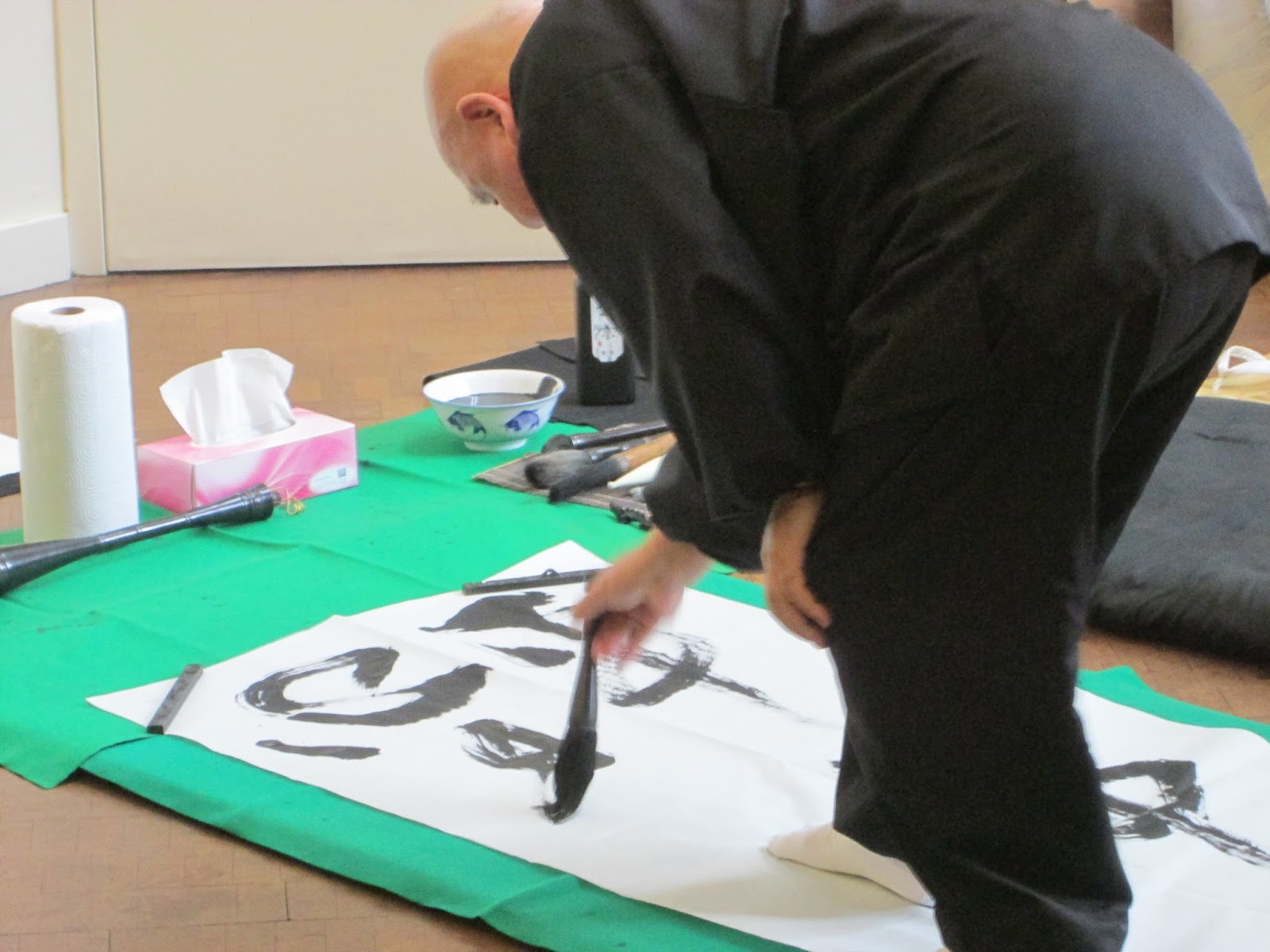
Almost every year since the mid-1990's Ajari Tanaka has visited Middlebury College to conduct a Shodo (traditional Japanese calligraphy) demonstration for and Asain Art class.  Here is a collection of photos that tell the story of this year's visit.


This year's audience was a little smaller than usual, but it made the even all the more accessible and relaxed.

Ajari Tanaka explaining his personal daily practice of Oshakyo, sutra copying.  Ajari's usual choice for this practice is the Heart Sutra.
Ajari's opening remarks about the significance of the paper, brush, ink and ink stone.

The first piece was a large "enso" or circle, and very ghosty example of the character "ku" or emptiness.
This is a classic piece that Ajari Tanaka has done many times, "peaceful face, lovely speaking"
Here he is brushing out Master Bassho's famous haiku about the old pond, the frog and the infamous jump.
Ajari beginning a piece that read "Hei Jo Shin".

"Hei Jo Shin" literally means "flat, always, heart".  But a translation that more closely mirrors its true meaning is "always maintain equanimity" of "keep an even mind". 

Ajari Tanaka patiently waiting for his assistant to ready the next piece of rice paper. 
Ajari Tanaka using some small media, for single characters.

Here Ajari Tanaka is explaining the meaning of these characters.  In his left hand is "Ku" or emptiness and in his right hand is "Ai" or love.
I know this shot is a little blurry but I bet you get the idea...