Monday, July 17, 2017

An Examination of Meditation and the Eightfold Path


"The eightfold path is the best of ways."

From the "Dhammapada" and its chapter entitled, "The Way" 
(TDP, p. 75)

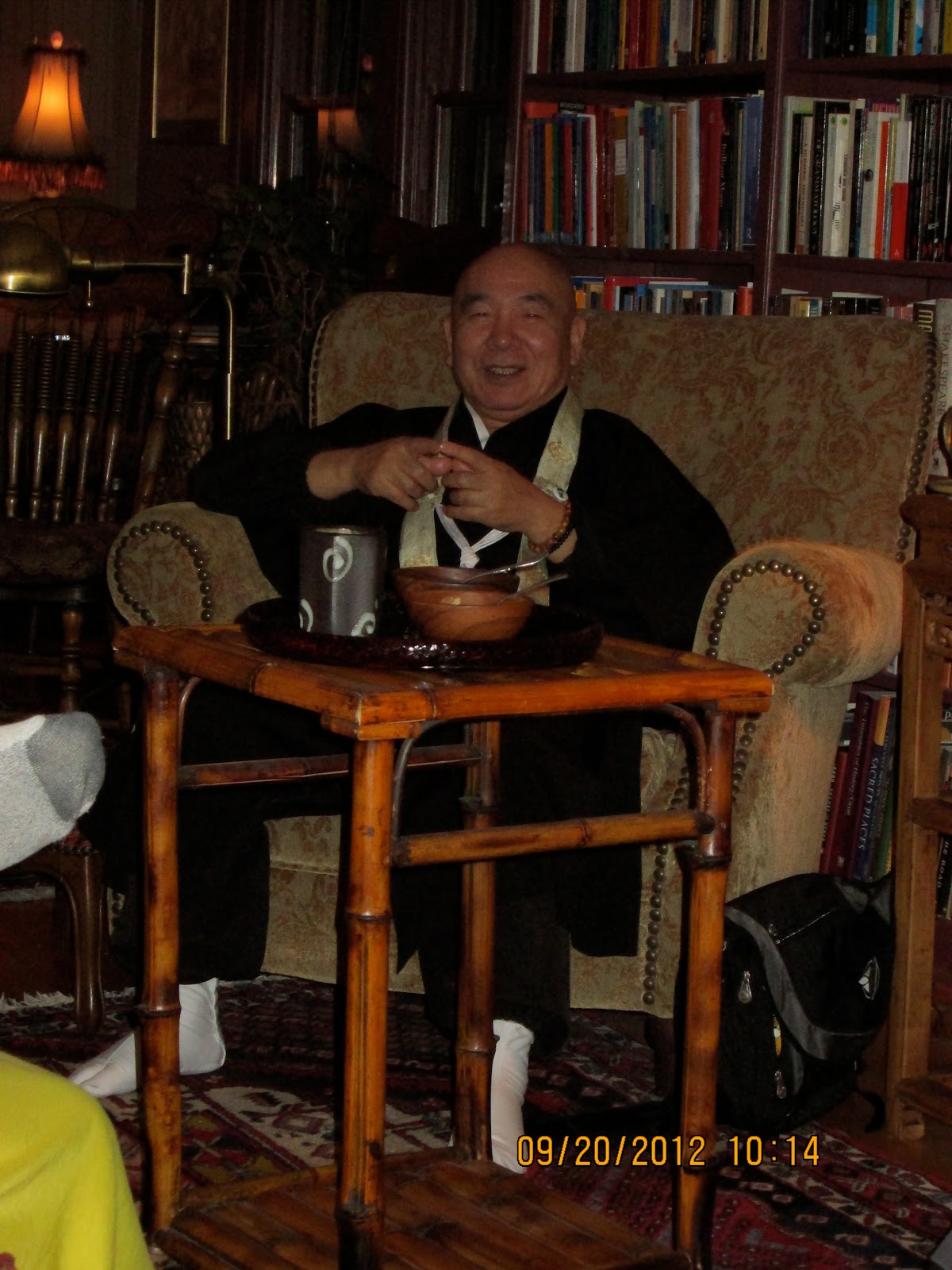
One of the most interesting things about studying with Ajari Tanaka is his deep appreciation and emphasis on the teachings of Shakamuni Buddha. That might seem like a ridiculous way to characterize ones Dharma teacher, but it's true. In this respect Ajari Tanaka is an intriguing combination. As one of Japan's only Shingon masters actively teaching Western students, he's worked tirelessly to share a mostly unknown Tantric system of practice as well as help us appreciate the profundity of Kobo Daishi Kukai's teaching and contribution to Japanese thought, history and culture.  But, all the while he keeps lecturing on the teachings of Buddhism's original founder, especially those that are earliest and most fundamental.

As a young man Ajari Tanaka spent five years in India with the express purpose of connecting with what the historical Buddha taught.  Over the course of his teaching in US, Canada and Europe he has often given Dharma talks inspired exclusively by Gotama Buddha.  In Japan he regularly devotes entire semesters at Waseda University to the Dhammapada or the Sutta Nipata.  Here in Vermont he has given an untold number of Dharma talks in our retreats on the life of the Buddha. Many of his North American students have heard him take a big in-breath, then say, "Shakamuni Buddha" and talk for the next hour.

So Ajari Tanaka has given us ample encouragement to explore and build our understanding of these original Dharma teaching.  They represent an important part and perhaps an under-examined part of our training.  Ajari Tanaka has demonstrated over time and through his consistent emphasis that it is important to study these dharmic fundamentals.  Without coming out and giving us homework, he is suggesting in an indirect way that we make a genuine effort to bring Shakamuni's Dharma into our Mikkyo practice.

So armed with that inspiration, this post will attempt explore some of the basics of the Noble Eightfold Path.  Not a deep dive into each element, but a start.  First a look at the context and characteristics of the path and then practice of meditation within it.  Ajari Tanaka has continually stressed that personal daily practice is first and foremost, so we'll take that as a guide in beginning to appreciate the Noble Eightfold Path.

(Those interested in very comprehensive treatment of the Noble Eightfold Path, please refer to the books listed in this post's bibliography.)  

The Noble Eightfold Path, or the "Ariya Atthangika Magga" (WBT, p. 45) is counted among Shakamuni Buddha's earliest teachings.  It is the fourth of the Four Noble Truths.  Recognizing the universality of suffering (the First Noble Truth) as the principle human problem, the Buddha gave the Noble EightFold Path as its cure.  It is the way he posited that by our own effort we could each bring about the end of suffering.

The Buddha referred to the Noble Eightfold Path specifically as:

"...the path leading to the cessation of suffering..."
(FDB, p. 19).

Understood in this most basic context, the Noble Eightfold Path offers not only practical, but almost elemental value to our lives.

Master Kukai locates the Eightfold Path in our study and practice of Shingon in his "Precious Key to the Secret Treasury". From the section regarding the Fourth Level of Mind, Master Kukai states the following:

"The great Buddha, the World Honored One, therefore preached the Goat Vehicle in order to save the people from the extreme suffering of falling into the Three Evil Paths and to release them from the karmic fetters of the Eight Sufferings.  His teaching is to promote the study of the Tripitika and to observe widely the Four Noble Truths."
(KMW, p. 176)

Here we can see Kobo Daishi Kukai identifying the Four Noble Truths and the Noble Eightfold Path as the Fourth Level of Mind.  Therefore indispensable in our Shingon Path as each level of Mind must be reached, learned, practiced and internalized if the fruition of the Shingon teachings are to be realized.

Turning now to an English language version of the Buddha's first teaching, very early in the translation we find the following:

"...the Tathagata has realized the Middle Path.  It produces vision, it produces knowledge, it leads to calm, to higher knowledge, to enlightenment, to nibbana."
(FDB, p. 17)

Here the Buddha begins to describe what he discovered in his meditation, as well as the result of that discovery.  But what is the Middle Path precisely?  First, the Buddha teaches that the path is characterized by its navigation between two extremes.

"O bikkhus, one who has gone forth from worldly life should not indulge in these two extremes.  What are the two? There is indulgence in desirable sense objects, which is low, vulgar, worldly, ignoble, unworthy and unprofitable and there is devotion to self-mortification, which is painful, unworthy and unprofitable."
(FDB, p. 17)

Even though we may have not "gone forth from worldly life", avoiding what is "unworthy and unprofitable" sounds like pretty good advice.  Even in the context of lay life, it just makes sense that being continually too easy on oneself or incessantly hard is problematic. Vacillating between the two seems even worse.  In the context of trying to develop a genuine meditative discipline within the demands of our daily life this kind of self criticism and/or indulgence can undermine our efforts.

Its safe to say that modern, lay life is full of creature comforts, entertainments and diversions.  Today's world makes the pursuit of the enjoyable as easy as its ever been.  In contrast it is equally tempting to endlessly scold ourselves when trying to develop a meditative discipline. It is far too easy to demonize the inevitable lapses in practice that happen or to get overly focused on (and judge negatively) the distracted nature of the mind while sitting in meditation.

So the simple necessity of taking a balanced approach to our lives and practice is established by the Buddha straight away. Of course the Buddha's definition of the extremes may be a bit bigger than our own. He lived a royal life as a young man and then was a hardcore ascetic. Our version of the extremes may be more modest.  But they still exist - pushing too hard or not pushing enough all happens continually.

What seems most important is to recognize that this emphasis on balance is the context the Buddha set for the other teachings he shared.

The Buddha goes on, and as is characteristic of his teaching style, he gives a detailed list:

"And what is that Middle Path, O bhikkus, that the Tathagata has realized?  It is simply the Noble Eightfold Path, namely: Right understanding, right thought, right speech, right action, right livelihood, right effort, right awareness, and right concentration.  This is the Noble Eightfold Path realized by the Tathagata.  It produces vision, it produces knowledge, it leads to calm, to higher knowledge, to enlightenment, to nibbana."
(FDB, p. 17)

Just running down that list, without knowing anything of the specifics of what the Buddha precisely meant by understanding, thought, speech, action or all the rest, the Eightfold Path appears as a comprehensive, common sense way we might approach life.

No matter what kind of life we lead, there are a lot of moving parts.  Its not a stretch to imagine that it might be helpful if we not only identified and paid attention to those differing aspects of our life, but also tried to make some improvement. Attending closely to our thinking, our speech, what we do, how we earn a living, what kind of energy we bring to our lives, all seems almost blandly practical.  But at the same time, simply just plain smart.

But before we dig in and try to understand any specific dimension of this path a little bit more, it's important define the term "right." Each aspect of the path is prefaced with the term and so "right" must carry some significance worth defining.

In his work entitled, "The Myth of Freedom" in a section devoted to the Noble Eightfold Path, Chogyam Trungpa gives this comment:


"...we first must understand what the Buddha meant by "right." He did not mean to say right as opposed to wrong at all.  He said "right" meaning "what is," being right without the concept of what is right."

(MOF, p. 95)

So the Buddha's "right" is not a relative term. Trunpa suggests the use of "right" in this context has more to do with the reality of our understanding, our thoughts and actions and the rest.

Trungpa further elaborates on his meaning, providing these additional specifics:


"Right" translates the Sanskrit "samyak", which means "complete."  Completeness needs no relative help, no support through comparison; it is self-sufficient.  Samyak means seeing life as it is without crutches, straightforwardly.
(MOF, p. 95)

Knowing now that right is "samyak" or "complete" we can restate the Eightfold Path - Complete Understanding, Complete Thought, Complete Livelihood, Complete Effort, Complete Meditation, etc. This results in a different feeling for the elements of the path.  It give a sense of perfecting these dimensions of life. Developing them to the point that our experience is complete - nothing more need be added and perhaps equally important, nothing remains to be removed.

Armed with a basic notion of "samyak", we can turn our attention to another useful English language resource. "What the Buddha Taught" by Walpola Rahula dissects the Eightfold Path into what Master Kukai calls the "Three Items of Mastery".  Which are:

"Observance of the precepts, practice of meditation and obtaining wisdom"
(KMW, p. 172).

The "Three Items of Mastery" are commonly referred to by the Sanskrit terms Sila, Samadhi and Prajna.  In his note on the three, Prof. Hakeda states that they are:

"...the most comprehensive summary of the way of life and practice, and of the goal of Buddhists."
(KMW, p. 172)

Professor Hakeda was a Shingon Acharya and life long scholar practitioner who lived for many years in the States. He was an accomplished translator and a respected professor at Columbia University as well as a friend of Ajari Tanaka's.  When he states that the Three Items of Mastery, which are synonymous with the the Eightfold Path, are the "goal of Buddhists" he gives a clear indication of the universal applicability of Shakamuni's original conception of the path.  Especially in the context of Mikkyo practice and study.

Returning to Rahula, here is how the Noble Eightfold Path is divided into the Three Items of Mastery:

Sila, or Discipline
  • Right Speech
  • Right Action
  • Right Livelihood
(WBT, p. 46 - 47)

Samadhi, or Meditation
  • Right Effort
  • Right Mindfulness
  • Right Concentration
(WBT, p. 47 - 48)

Prajna, or Insight/Knowledge/Wisdom
  • Right Thought
  • Right Understanding
(WBT, p. 49)

Regarding the deep and broad nature of these teachings, Rahula states the following:

Practically the whole teaching of the Buddha, to which he devoted himself during 45 years, deals in some way or other with this Path.  He explained it in different ways and in different words to different people, according to the stage of their development and their capacity to understand and follow him.  But the essence of the many thousand discourses scattered in the Buddhist Scriptures is found in the Noble Eightfold Path.
(WBT, p. 45 - 46)

Rahula, in the strongest of terms asserts the utter centrality of the Noble Eightfold Path within all of Shakamuni Buddha's teaching.

And because we don't have forty-five years for this post we will not attempt to dive into all eight aspects of Shakamuni's path.  As mentioned earlier, if one is so inspired, please refer to the resources listed in the bibliography below (I hope you won't be disappointed).

But what we will tackle is that element of the path that is most closely aligned with Ajari Tanaka's approach to teaching and training students. This directs us towards meditation, the practice of samadhi.

In all the years Ajari Tanaka has taught in the West, he has always kept an unrelenting focus on practice.  Whether it be silent meditations, endless recitations, finger tangling mudra, visualizations or sadhana, his continuous emphasis indicated a confidence in the power of practice to unlock the totality of the path.  Once a student gained an understanding of themselves though the natural inquiry that occurs in meditation (whatever the method), the other dimensions of the path - bringing ordered discipline to our lives or experiencing broader understanding, penetrating insights or empathy for others - all that would naturally arise as an outcome of that strong, consistent practice.

And within the three dimensions of Samadhi, we will further constrain our exploration to Right Mindfulness. 

In Pali, Right Mindfulness is "samma sati" (WBT, p. 45).  In a series of lectures given at Karma Triyana Dharmachakra (the North American Seat of His Holiness the Karmapa) Dzogchen Ponlop gave the Sanskrit for "sati" as "smirti."  During these lectures, Ponlop defined smirti as "recollection" or "memory". But not "recollection" in the sense of remembering something from the past, but rather to recollect or recognize the present moment (FFM, t. #1).  So mindfulness in this context is the concerted effort to first recognize, then come back to and eventually abide in the present moment.  And samyak smirti, would be its fruition, the complete re-collection within this present moment.

This echoes themes Ajari Tanaka has spoken to often.  Many of us have heard him say we must "wake up" to "this present moment, right now."

Master Kukai's poetry perhaps captures it best.  In the Iroha we find:

"Today cross over the deep mountains of life's illusion and there will be no more shallow dreaming..."
(SCE, p. 213)

Turning back to Rahula, he expands the specific meaning and dimensions of Right Mindfulness:

"Right Mindfulness (or Attentiveness) is to be diligently aware, mindful and attentive with regard to (1) the activities of the body (kaya), (2) sensations or feelings (vedana), (3) the activities of the mind (citta) and (4) ideas, thoughts, conceptions and things (dhamma)."
(WBT, p. 48)

Known commonly as the "Four Foundations of Mindfulness" Rahula locates this practice among the Buddha's teachings as follows:

"These four forms of mental culture or meditation are treated in detail in the Satipatthana-sutta..."
(WBT, p. 48)

In addition Rahula identifies a core practice associated with the development of Right Mindfulness:

"The practice of concentration on breathing (anapanasati) is one of the well-known exercises, connected with the body, for mental development."
(WBT, p. 48)

Regarding meditations Ajari Tanaka taught Aji-kan first and emphasized it strenuously as one of our core practices. During our two hour Sunday morning practice sessions held at Vermont's original Mandala Buddhist Center, many started with forty-five minutes of Ajai-kan.  After entering the dojo, doing our prostrations, Ajari would say, "face the wall".  This meant to gaze at the Aji image and practice this essential method until the gong sounded.

Years later, Ajari Tanaka taught "Gaccharin-kan", or full moon meditation.  In subsequent years Ajari has said that this meditation is very ancient and predates Shingon's arrival in Japan.

And again, years later, Ajari introduced "Susoku-kan" or "breath counting meditation."  This method, that utilizes counting the exhalations has much in common with Zazen, central to Japan's Zen traditions and the Shamatha practices common in the Tibetan traditions.  But more importantly it was directly connected to Shakamuni's teaching on the Four Foundations.

"O bhikkus, the method of being fully aware of breathing, if developed and practiced continuously, will have great rewards and bring great advantages.  It will lead to success in practicing the Four Establishments of Mindfulness.  If the method of the Four Establishments of Mindfulness is developed and practiced continuously, it will lead to success in the practice of the Seven Factors of Awakening.  The Seven Factors of Awakening, if developed and practiced continuously, will give rise to understanding and liberation of the mind."
(AH, p. 10)

This passage is from the Anapanasati Sutta.  Here the Buddha identifies the simple method of bringing awareness to our breathing as the practice that opens the door to understanding our minds and ultimately liberating our minds.  The method Susoku-kan that Ajari Tanaka taught us late in our training, is that critical first step to our enlightenment.

Each year we have a retreat, usually near the end of Ajari's visit. It is our most important event of the year. It is never a large event.  Usually not more than twenty people.  But to our small sangha this is big stuff. Local longtime sangha folks, hardworking students who live outside Vermont - New York, Philadelphia, Maine, Ottowa, Toronto - and of course new friends and students, they all descend on Vermont to practice together and spend time with our teacher.

During his Vermont visit in September 2015, due to a quirk of the schedule we were able to have an early practice intensive with Ajari Tanaka.  Compared to the main retreat that year, this opening weekend was sparsely attended.  Just five of us joined Ajari at our New Haven (VT) dojo.

As is customary, we certainly practiced many of our core methods - prostrations, Sanmitsu-kan, Goshinbo, Enmei Juku Kannon Gyo, Hannya Shingyo, dharani and mantra - all the recitation and attending mudra that populate our group practice style.  But what set this event apart from all others was our meditation. During this retreat Ajari Tanaka had us practice just simple sitting, Susoku-kan. In this event we just sat and paid attention to our breathing more than we ever had before.

In between simply sitting, Ajari talked quietly but passionately about the primacy of Anapanasati Yoga, following one's breathing. He encouraged its strenuous practice.  The way he shared his thoughts and how he lead us in practice fostered meditations that were particularly deep and rich.  This intensive was a clear example of Ajari's teaching genius. Those of us who attended remember the palpable experience of stillness and quiet.


Ajari Tanaka started teaching Western students in 1978.  The years since are marked by an unrelenting effort to transmit Shingon to the students that gathered.  First he vigorously taught a practice curriculum of esoteric fundamentals.  Brick by brick he built our practice foundation. Then he worked to produce a corpus of Shido Kegyo texts that represent the proper practice of these core sadhanas in accord with his lineage. The work continued, training his senior students in the practice of these sadhanas.  And most recently, he has charged those senior students with welcoming and supporting new students.

So after thirty-seven years of teaching and training students in a rare, almost unknown Tantric tradition, he returned for two days to Dharma's most basic meditation.  Those of us who have been with Ajari Tanaka for a long time, this event was nothing short of remarkable.  It felt like the completion of a very long cycle.

Maybe it was the quiet and still fruition of all those years of wondrous effort.

__________________________________________________________________

Bibliography
The Dhammapada, Balangoda Ananda Maitreya, Parallax Press, 1995, abbreviated in notation as (TDP, p. XX)

The First Discourse of the Buddha, Dr. Rewata Dhamma, Wisdom Publications, 1997, abbreviated in notations as (FDB, p. XX)

What the Buddha Taught, Walpola Rahula, Grove Press, 1959, abbreviated in notations as (WBT, p. XX)

Kukai: Major Works, Yosito S. Hakeda, Columbia University Press, 1972, abbreviated in notations as (KMW, p. XX)

The Myth of Freedom, Chogyam Trungpa, Shambhala, 1976, abbreviated in notations as (MOF, p. XX)

Exploring the Four Foundations of Mindfullness, Dzogchen Ponlop Rinpoche, translated by Lama Yeshe Gyamtso, at Karma Triyana Dharmachakra, Woodstock NY, April 4 - 6, 2014, recorded by Dharma Echoes abbreviated in notes as (FFM, t. X)

Sacred Calligraphy of the East, Third Edition, John Stevens, Echo Point Books & Media, 2013, abbreviated in notes as (SCE, p. XX)

Awakening of the Heart, Thich Nhat Hanh, Parallax Press, 2012, abbreviated in notes as (AH, p. XX)

Friday, August 26, 2016

The Marvelous Workings of the Buddha Mind...

"Because the Buddha Mind is present in each one of you, there is no question of my giving you the Buddha Mind.  Listening closely to this sermon, realize the Buddha Mind that each of you has right within himself, and from today on you're abiding in the Unborn Buddha Mind.  Once you've affirmed the Buddha Mind that everyone has innately, you can all do just as you please: if you want to read the sutras, read the sutras; if you feel like doing zazen, do zazen; if you want to keep the precepts, take the precepts; even if it's chanting the nembutsu or the daimoku, or simply performing your allotted tasks - whether as a samurai, a farmer, an artisan or a merchant - that becomes your samadhi.  All I'm telling you is: "Realize the Buddha Mind that each of you has from your parents innately! What's essential is to realize the Buddha Mind each of you has, and simply abide in it with faith..."


This is quoted from "Bankei Zen" translated by Peter Haskel.  Mr. Haskel was a student of Prof. Yoshito Hakeda during his tenure at Columbia University.  Prof. Hakeda was the author of both "Kukai: Major Works" and "Awakening of Faith" as well as a personal friend of Ajari Tanaka.  Professor Hakeda assisted Mr. Haskel and is named the Editor of this book.  It is a really wonderful read and continually echos Kukai's teaching on achieving buddhahood in this very body...

(Bankei Zen, translated by Peter Haskel, edited by Yoshito Hakeda, Grove Weidenfeld, 1984, p.49)

Tuesday, May 24, 2016

More Dhammapada...

Better than on hundred years lived
With an unsettled [mind],
Devoid of virtue,
Is one day lived
Virtuous and absorbed in meditation.

Better than one hundred years lived
With an unsettled [mind],
Devoid of insight,
Is one day lived
With insight and absorbed in meditation.

Better than on hundred years lived
Lazily and lacking in effort
Is one day lived
With vigor and exertion.

Better than one hundred years lived
Without seeing the arising and passing of things
Is one day lived
Seeing their arising and passing.

Better than one hundred years lived
Without seeing the Deathless
Is one day lived
Seeing the Deathless.

Better than on hundred years lived
Without seeing the ultimate Dharma
Is one day lived
Seeing the ultimate Dharma.


From "The Dhammapada" translated by Gil Fronsdal, published by Shambhala Publications, Inc. (2005, p. 28 - 29)

Monday, May 23, 2016

Samplings from the Dhammapada; Part #1


Not long after Ajari Tanaka moved back to Tokyo in 1999, after his twelve year stay in Vermont, he was awarded a post at Waseda University.  Waseda is a very large and prestigious institution of higher learning and Ajari's position was in a vibrant continuing education division that serves all kinds of students, but especially older folks who have retired from busy lives in business and raising families.  These students want to reignite learning and enrich their lives now that their obligation to family and society are fulfilled.

Naturally, Ajari Tanaka teaches on Buddhist topics exclusively.  Since the very beginning of his tenure at Waseda, Ajari has regularly devoted many semesters to teaching his university students about the Dhammapada, one of Buddhism most fundamental texts.  Far from his own tradition and training in Japan's quintessential esoteric, tantric tradition, this effort on the part of Ajari Tanaka reflects his deeply held feeling that the orignal teachings of Shakamuni are of central importance to all students of Dharma.

Below are a collection of excerpts from a high quality English language version of the Dhammapada.  Though there are many wonderful translations of this core Buddhist text the one in use here is translated by Gil Fronsdal published by Shambhala Publications Inc. in 2008.

Enjoy...


One who recites but a few teachings
Yet lives according to the Dharma,
Abandoning passion, ill will, and delusion,
Aware and with mind well freed,
Not clinging in this life or the next,
Attains the benefits of the contemplative life.

From the chapter entitled "Dichotomies", p. 7

Absorbed in meditation, persevering,
Always steadfast,
The wise touch Nirvana,
The ultimate rest from toil.

From the chapter entitled "Vigilance", p. 8

The restless, agitated mind,
Hard to protect, hard to control,
The sage makes straight,
As a fletcher the shaft of an arrow.

From the chapter entitled "The Mind", p. 11

Do not consider the faults of others,
Or what they have or haven't done.
Consider rather
What you yourself have or haven't done.

From the chapter entitled "Flowers" p. 15

The way to material gain is one thing,
The path to Nirvana another.
Knowing this, a monk who is the Buddha's disciple
Should not delight in being venerated,
But cultivate solitude instead.

From the chapter entitled "The Fool", p. 19

Virtuous people always let go.
They don't prattle about pleasures and desires.
Touched by happiness and then suffering,
The sage shows no sign of being elated or depressed.

From the chapter entitled "The Sage" p. 21

Calm in mind, speech, and action
And released through right understanding,
Such a person
Is fully at peace.

From the chapter entitled "The Arahant", p. 24

Though Ajari Tanaka has not specifically taught much on the Dhammapada here in Vermont, his focus with us has been to plant firmly the teachings of Shingon practice.  Despite that, some of his students have undertaken the study of the Dhammapada in its various English translations.  The more our familiarity grows with the view, priorities and guidance in the Dhammapada the more clearly we see our own teacher.  Ajari's behavior, demeanor and personality are all wonderfully reflected in the text's passages.  The utter simplicity, the crystal clear sanity, the genuine openness and quiet strength that the Dhammapada projects are all effortlessly manifested by Ajari Tanaka.   As the years of training with Ajari Tanaka pile up, our gratitude for who he is, how he's trained us and what he has shared only magnifies.


We all hope that many more interested students get to experience what we have and please know you are all welcome...


Friday, May 20, 2016

Awakening of Faith #2

How does the permeation [of Suchness] give rise to the pure state and continue uninterrupted?


It may be said that there is the principle of Suchness, and it can permeate into ignorance.

Though the force of this permeation, [Suchness] causes the deluded mind to loathe the suffering of samsara and to aspire to nirvana.

Because this mind, though still deluded, is [now] possessed with loathing and aspiration, it permeates into Sucness [in that it induces Suchness to manifest itself].

Thus a man comes to believe in his essential nature, to know that what exists is the erroneous activity of the mind and that the world of objects in front of him is nonexistent, and to practice teachings to free himself [from the erroneously conceived world of objects].

He knows what is really so -

From "The Awakening of Faith", attributed to Asvaghosha, translated with commentary by Yoshito S. Hakeda (p. 58, 1967, Columbia University Press)

Note - the breaks in the above quoted text do not reflect the original presentation.  They have been added in hopes that they assist the reader in following the progression and logic of the quoted text.  Any and all distortion of the original meaning is the fault of the transcriber.


Awakening of Faith, #1

How does the permeation [of ignorance] give rise to the defiled state and continued uninterrupted?  


It may be said that, on the ground of Suchness [i.e., the original enlightenment], ignorance [i.e., nonenlightenment] appears.

Ignorance, the primary cause of the defiled state, permeates into Suchness.

Because of this permeation a deluded mind results.

Because of the deluded mind, [deluded thoughts further] permeate into ignorance.

While the principle of Suchness is yet to be realized, [the deluded mind], developing thoughts [fashioned in the state] of nonenlightenment, predicates erroneously conceived objects of the senses and the mind.

These erroneously conceived objects of the senses and mind, the coordinating causes in [bringing about] the defiled state, permeate into the deluded mind and cause the deluded mind to attach itself to its thoughts, to create various [evil] karma, and to undergo all kinds of physical and mental suffering.


"The Awakening of Faith", attributed to Asvaghosha, translated with commentary by Yoshito S. Hakeda (p. 56 - 57, 1967, Columbia University Press)

Note - the breaks, bolding and layout of the above copied text do not reflect the original published presentation.  They have been added in hopes to help the reader follow the linked progression and logic of the selection.  Any distortion of the original meaning is mine and my own.

Monday, May 16, 2016

Shingon goes north...

Ajari Tanaka has a wonderful student (Mat-san) who lives just over the border from Ottawa, Canada's capital, in a lovely town in western Quebec.  Besides working hard and raising two daughters he has been committing considerable time to training in Shingon for a growing number of years.  In addition to Ajari's Fall visits, Mat has become a regular Mandala Vermont Sangha member, visiting throughout the year to receive instruction and practice intensively with our long-time Vermont practitioners.

Not long ago we hatched a plan with Mat to see if folks in the Ottawa area might be interested in giving Shingon practice a try.  As luck would have it both fantastic folks and a very conducive place were discovered for us to have our first Shingon practice seminar in this fantastic part of Canada.

So we packed up...


...and headed out.

An additional stoke of luck allowed us to scoop up one of Ajari's senior most students, Pete-san.  With over 21 years of practice and study under his belt we were happy to have his experience to share with these new students in this new place.  He also made us laugh for almost the entire six hour trip.


We arrived without event at Mat's home in a quaint Quebec suburb of Ottawa.  His home was not only inviting but we were greeted by his two daughters who could not have been any more cute.  Relaxing, we had a nice snack and eased back after the long drive.

Not long after we had to say goodbye to the girls and get ready to go see the city.  Another friend who was traveling with us asked Mat to tell his daughters that we were happy to meet them and that they were beautiful.  As they only speak French, Mat relayed the message and no sooner was it deliver than they turned to us and in unison said, "Merci" in the sweetest little girl voices you could ever imagine. Utterly fantastic...

And with that we were off to tour Ottawa....


Ottawa is beautiful, set on the convergence of three rivers and filled with history.  We walked Parliament Hill, saw where the various ambassadors to Canada had their residences, strolled downtown a bit, saw some stone lions Mat's ancestors helped carve and ended at an Irish pub.  It was a great outing.


Strangely enough we connected with another Mandala Vermont student of Ajari Tanaka's (Jamie-san) who happened to be in Ottawa for a professional seminar.  We not only convinced him to join us for our dinner that night, but to stay for our meditation seminar on Sunday.  We were not only happy to run into our old friend but stoked to enlist another experienced student to help share the practice with the new folks Mat had assembled.  So now we had four sangha members to help establish the new northern frontier of Shingon.  That run of good luck signaled that it was time for sushi...

Lots and lots of sushi, and sashimi, and crazy appetizers and as you might notice in the foreground, very tall Asahi's.  After more than we probably needed we headed back to Mat's house to rest up for the the next day's events.  The trip up and the day spent with old and new friends in this amazing Canadian city could not have been better.
Up early the next morning, we had a good and bumpy drive through fantastic Quebec scenery to our practice place.  Our dojo for the day was a place called "Chez Alice" in the very cool town of Wakefield Quebec.  Wakefield is a super funky artist's enclave and remote vacation destination.  Very small and wonderfully cozy, Wakefield sits right on the Gatineau River.  The town is just a sliver of civilization on the southern side of the river which is broad and surrounded by rugged land - rocky outcrops, steep hillsides with deep patches of evergreens.  Chez Alice is primarily and artist's studio, but doubles as a Karate Dojo among other things.  Today it is our Pure Land.


Ten people came to Chez Alice for the morning session. Without hesitation,we dove right in.  Over the course of our morning we sampled and shared a selection of meditations, sutra recitation, mantra and mudra.  The morning flew by and folks shared their great attention and energy for our practice.  At the end of this first session there was a palpably happy feeling in the room.  

And nothing signals its time for lunch like a bunch of happy people...


For lunch, the local fare was yummy and the conversation was even better.  The more we got to know the folks Mat had gathered the more we both felt at home and a real, growing connection to the people and place.  But before long, completely due to having to much lunch fun and ordering dessert, we were late for our afternoon start time.

So we bolted back to Alice's place and started up.  

Two folks from the morning couldn't stay for the afternoon, but two new folks joined our practice so we were again at ten practitioners.  The afternoon went by in a blur of instruction, meditation, mudra, visualization and recitations.  Everyone was both wonderfully receptive and made a fantastic effort in the practice.  But, before we all knew it, our time together was at its end.  


In our closing comments to the group, Mat offered to make group practice available for local folks who were interested.  The travelers from Mandala Vermont committed to coming back anytime our new friends in Shingon's northern most outpost want to practice together again.  We are so grateful to both Mat and all the folks we met on this trip for making us feel so welcome and sharing their spirit with us.  

Totally can't wait to go back...

P.S. - a group practice lead by our local student (Mat-san) has happened recently inspired by local interest - oh yeah...  

Yay, yay, yay...


Sunday, August 9, 2015

Vimalakirti


By killing the culprit klesa
Is his boldness unsurpassed.
By defeating four demons
He plants his triumphant banner as a bodhimandala.
Though he knows there is neither birth nor death
He is reborn to show himself to all,
Appearing in many countries
Like the sun seen by everyone.
When making offerings to countless
Buddhas in the ten directions
He does not discriminate
Between himself and them.


The Vimalakirti Nirdesa Sutra translated by Charles Luk (Shambhala, 1990, p. 88)

Melodies...


Hymns, chants and intonations of Dharma are his melodies...


From the "Vimalakirti Nirdesa Sutra" (Translated by Charles Luk, Shambhala, 1990, p. 86)

The Bodhisattva's Companions

His wife is joy in the Dharma's law,
Kindness and pity are his daughters,
His sons morality and truthfulness,
Absolute voidness his quiet abode...


From the "Vimalakirti Nirdesa Sutra" (Translated by Charles Luk, Shambhala, 1990, p. 86)
Wisdom-perfection is a Bodhisattva's Mother,
His father is expedient method,
For the teachers of all living beings
Come only from these two...


From the 'Vimalakirti Nirdesa Sutra (Translated by Charles Luk, Shambhala, 1990, p. 86)

Monday, January 19, 2015

Unanticipated dharma in the car...

Our sangha is small.  Very small.  Because we are so small, we enjoy a lot of ordinary moments with our teacher, Ajari Jomyo Tanaka.  

A few of us might make and have breakfast with him.  Eight or ten of us may go out to dinner with him.  Our retreats never exceed fifteen or twenty people.  Often times we find ourselves alone with him.  Not surprisingly, some of the most memorable things happen in these ordinary moments.

During Ajari Tanaka's visit in September 2014 I enjoyed one of these moments while driving him somewhere.  I don't even remember where.

We were leaving the home of a couple of long time sangha members who were hosting Ajari Tanaka in Burlington.  We were driving up Cliff Street, which is an incredibly steep hill surrounded by a wonderful Burlington neighborhood just west of the University of Vermont's Redstone campus.  As we approached the intersection that borders the campus, I noticed a woman walking her dog.  The dog was tiny and it struck me funny as I have always had bigger dogs - huskies, yellow lab muts, even a wolf hybrid.  I giggled and without thinking I said, "people love their little dogs."

To my random comment Ajari responded, "little dogs are easy to control."  True and interesting enough.  Then Ajari added, "big dogs always control people."

Ajari continued, turning the discussion in a new direction.  "In Japan people like a robot dog.  A robot dog is easy to control.  And robot dogs never complain."

Then he casually said, "but all sentient beings complain."

Wow.  Now he suddenly had my attention...

Ajari continued,  "We get a new car, and we complain.  We get a new house and we complain, we get the marriage and we complain."

At this point I was kind of stunned.  In that completely ordinary, car ride Ajari Tanaka articulated a kind of self-centeredness that is so typical as to almost unnoticed.

Next he brought it all home...

"But we don't want to hear it."

With that comment, he let the whole conversation dangle.  Dangle in wide open space with no further elaboration offered or needed.  We drove for a good while in silence.

Though Shingon is a singularly Vajrayana tradition, Ajari Tanaka's presentation of it has a very Mahayana character.  The altruistic concern for others, the intrinsic obligation to share the happiness, strength, peace and the personal progress we experience from our practice has always been one of his core teachings.  This single comment, "we don't want to hear it", exposed a moment to moment unwillingness to embrace the bodhisattva path.  In that uncontrived moment, Ajari made it clear that if we are really aspiring bodhisattvas need to embrace that reality, for benefit of both ourselves and others.


Sunday, May 25, 2014

Followers of the way...

Followers of the Way, what Dharma do I expound?  I expound the Dharma of the Heart-ground.  This pervades everything;  it is in the worldly and in the sacred, in the pure and impure, the fine and the coarse.  The most essential thing is that you refrain from making labels, such as fine or coarse, worldly or sacred, and (mistakenly) think that by naming them you now know them.  But the fine and the coarse, the worldly and the sacred cannot be known to man by name only.  Followers of the Way, realize this and make use of it, but do not slap labels on it, for these tend to be like pen-names, only creating mystery.

From "The Zen Teachings of Rinzai" translated by Irmgard Schloegl (Shambhala Publications, 1975, p. 25)

Master Rinzai passed away in 866 AD,  just thirty-one years after our own founder, Kobo Daishi Kukai passed away on Mount Koya Japan.  Though Master Rinzai was a hard and iconoclastic teacher from the Zen tradition, much of his teachings echos in Kukai's words as well.  Perhaps Master Rinzai was a young dharma student while Master Kukai was in China studying under Hui-kuo...

Friendliness #1

This is what should be done by those who are skilled in seeking the good, having attained the way of peace:

They should be able, straightforward, and upright, easy to speak to, gentle, and not proud,
Content and easily supported, with few obligations and wants,
With senses calmed, prudent, modest, and without greed for other people's possessions.
They should not do anything base that the wise would reprove.
May they be at their ease and secure - may all beings be happy.


The above excerpt is from a short sutra given by Shakamuni Buddha known as the Metta Sutta as it is found in "Tonglen" by Pema Chodron (Vajradhatu Publications, 2001, p.128 - 129)


Tuesday, April 30, 2013

Mandala Training - Meditation as "Kan"

No matter where they originate, all the traditions and various schools of Buddhism include meditation as an intrinsic part of the path.  Shakyamuni Buddha achieved enlightenment under the Bodhi Tree by practicing methods he learned and discovered over six years of uninterrupted and consummately dedicated practice.  It's hard to imagine Buddhism without a genuine commitment to meditative discipline.  Ajari Tanaka's teachings are no different and reflect that intrinsic role meditation plays in the path of the buddhadharma in general and the Shingon tradition specifically.

Over the years of his teaching in the West, Ajari Tanaka has introduced three fundamental methods of meditation - Susoku-kan, Gaccharin-kan and Aji-kan.  Collectively, these methods reflect both the basic disciplines and the richness of the Shingon tradition.  It also demonstrates quite clearly Ajari Tanaka's vision for our path.  Each method compliments the others and serves students in a unique way.  Collectively they provide important tools to inspire personal development and at the same time build essential capacities necessary on our path.  Ajari Tanaka has been incredibly generous in sharing and training us in these methods over the years.  We are now grateful to be able to share them with interested students everywhere.

Ajari Tanaka brushing the syllable "KAN"
Before we try to understand the individual meditative methods, let's first explore the suffix "kan".  The Japanese names of Shingon methods of meditation are generally  referred to as some type of "kan",  like the examples mentioned above.  The kanji character used to express this word "kan" is the same character used to express the first syllable of the Japanese name of the well know Bodhisattva of Compassion, Kannon or Kanzeon.

Kanzeon translates roughly as "apprehend the world's sounds" while Kannon might be generally rendered as "apprehend the sounds".  In the context of this bodhisattva, the name indicates the uninterrupted attention to the suffering of all the beings in our samsaric world.  But in the context of Shingon meditations it indicates something important about the approach to meditation practice altogether.

The suffix "kan" suggest that in meditation we are seeing something worth noting.  In our practice we will apprehend things worth carefully attending to.  In meditation, the perceptions themselves are fuel that propels meaningful growth.  The term "Kan" suggests that by using the prism of meditation method we, ourselves are worth investigating.  Our own mind is worth paying close attention to.  By embracing meditative discipline we will see things about ourselves that are both meaningful, enriching and profoundly transformative.

By apprehending ourselves through meditation, unhurreid and patiently over time, utilizing the disciplines of method we can discover the things within us that are already complete, perfect and capable of making a real difference in our life and the lives of others.

We invite students of the buddhadharma everywhere to experience the practices that Ajari Tanaka has shared in his decades of teaching in the West.  Our experience is that they are unique, powerful and genuine.


Wednesday, April 17, 2013

Our training - an overview

Ajari Tanaka began teaching in the United States in 1978.  Since that time he has taught on a wide variety of subjects.  Within the broad reach of his teachings, Ajari Tanaka has emphasized certain things to the extent that they have become the building blocks of our training.  There are nine general dimensions that form the foundation of how we train.  Some come directly from Shingon, while others are practices and disciplines that Ajari Tanaka believes create meaning, add value or a certain richness to our path.  Collectively, these nine are the tools our teacher has shared with us to explore ourselves, our tradition and his vision.  They are the vehicles we use to progress along our path.

The nine dimensions of our training are:

  1. Meditation
  2. Recitation
  3. The practice of mudra
  4. Ritual
  5. Traditional, contemplative arts
  6. Healthy eating
  7. Exercise
  8. Study
  9. Helping others
During a karate lesson given during one of our early summer retreats, Ajari Tanaka's wife, Yukiko-san explained the Japanese term "keiko".  She explained that keiko meant "practice".  She left the impression that it was what we do to make progress, its what we do to spur personal growth, its what we do to uncover what we are really capable of.  Our nine dimensions of training are the "stuff" of our practice, it's our keiko.


Over the next weeks and months, we will explore more of the details of our training.  We will look into each dimension individually.  Our hope is this will help share a more complete understanding of our practices, the Shingon tradition and most specifically the teachings of Ajari Jomyo Tanaka.


 Stay tuned...

Tuesday, February 5, 2013

Liberation of the Mind


“Discipline is for the purpose of restraint, restraint is for the purpose of non- remorse, non-remorse is for the purpose of gladdening, gladdening is for the purpose of happiness, happiness is for the purpose of tranquillity, tranquillity is for the purpose of bliss, bliss is for the purpose of concentration, concentration is for the purpose of correct knowledge and vision, correct knowledge and vision is for the purpose of dispassion, dispassion is for the purpose of fading away [of greed], fading away is for the purpose of deliverance, deliverance is for the purpose of knowledge and vision of deliverance, knowledge and vision of deliverance is for the purpose of complete extinction [of craving, etc.] through not clinging. Talk has that purpose, counsel has that purpose, support has that purpose, giving ear has that purpose, that is to say, the liberation of the mind through not clinging.”


From The Visuddhimagga, The Path of Purification, by Bhadantacariya Buddhaghosa, translated by Bhikkhu Nanamoli (Third online edition, Buddhist Publication Society, 2011, p. 16)

Sunday, November 25, 2012

The Fivefold Wisdom #1

The Kongo-kai or Vajradhatu Mandala of Shingon has at its core the Five Wisdoms.  The following is Professor Hakeda's brief explanation of this essential teaching, which he refers to as the "Fivefold Wisdom symbolized by the Five Buddhas in the Diamond Realm."

1.) Wisdom That Perceives the Essential Nature of the World of Dharma (hokkai taisho chi); the eternal Source of gnosis, the Radiant, whose rays are to be differentiated in terms of the following four kinds of wisdom.  Thus wisdom, represented by Mahavairocana, is located in the center of the Diamond Mandala.

2.) Mirrorlike Wisdom (daienkyo chi): the wisdom that reflects reality as it is without distortion.  This wisdom is represented by Aksobhya (Ashuku), the Unshakable, located in the east.

3.) Wisdom of Equality (byodosho chi):  the wisdom that perceives the fundamental identity of all phenomena as issuing forth from the One Reality and that recognizes the absolute equality of all beings as to their intrinsic value.  It is represented by Ratnasambhava (Hosho), the Jewel Born, located in the south.

4.) Wisdom of Observation (myokanzatchi):  the wisdom that observes the objects of mind free from discriminations and subjective calculations.  It is represented by Amitabha (Amida), the Infinite Light, located in the west.

5.) Wisdom of Action (jososa chi): the wisdom that is manifested as actions to help bring all sentient beings to spiritual maturity and, finally, to enlightenment.  It is represented by Amoghasiddhi (Fukujoju), the Infallible Realization, located in the north.

From "Kukai: Major Works" by Yoshito S. Hakeda, (Columbia University Press, 1972, p. 83 - 84)

Monday, November 5, 2012

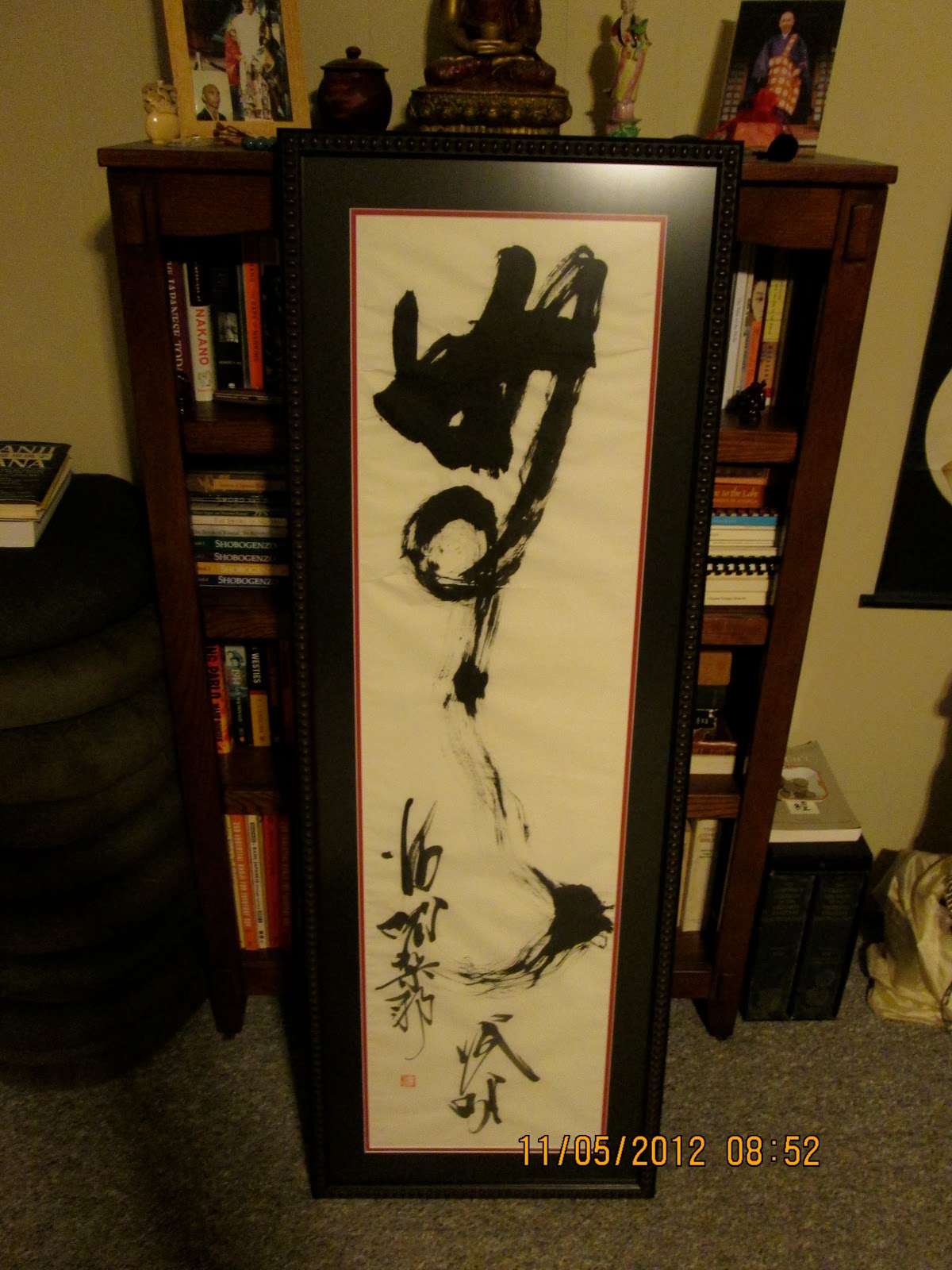
Perhaps the best "MU" ever...

During Ajari Tanaka's September visit we had a chance to review with him an incredible collection of his calligraphy that has amassed over the many years of his visits to Vermont.  To our surprise Ajari  seal stamped two pieces in the collection.  Both were done during Ajari's autumn visits soon after he moved from Vermont back to Tokyo (1999), maybe 2000 or 2001.

Recently we have been able to frame one of these pieces.  We think it's an amazing example of a character that Ajari Tanaka has done many times.  It's on of our favorite "MU's".

We hope you like it too...


Monday, October 15, 2012

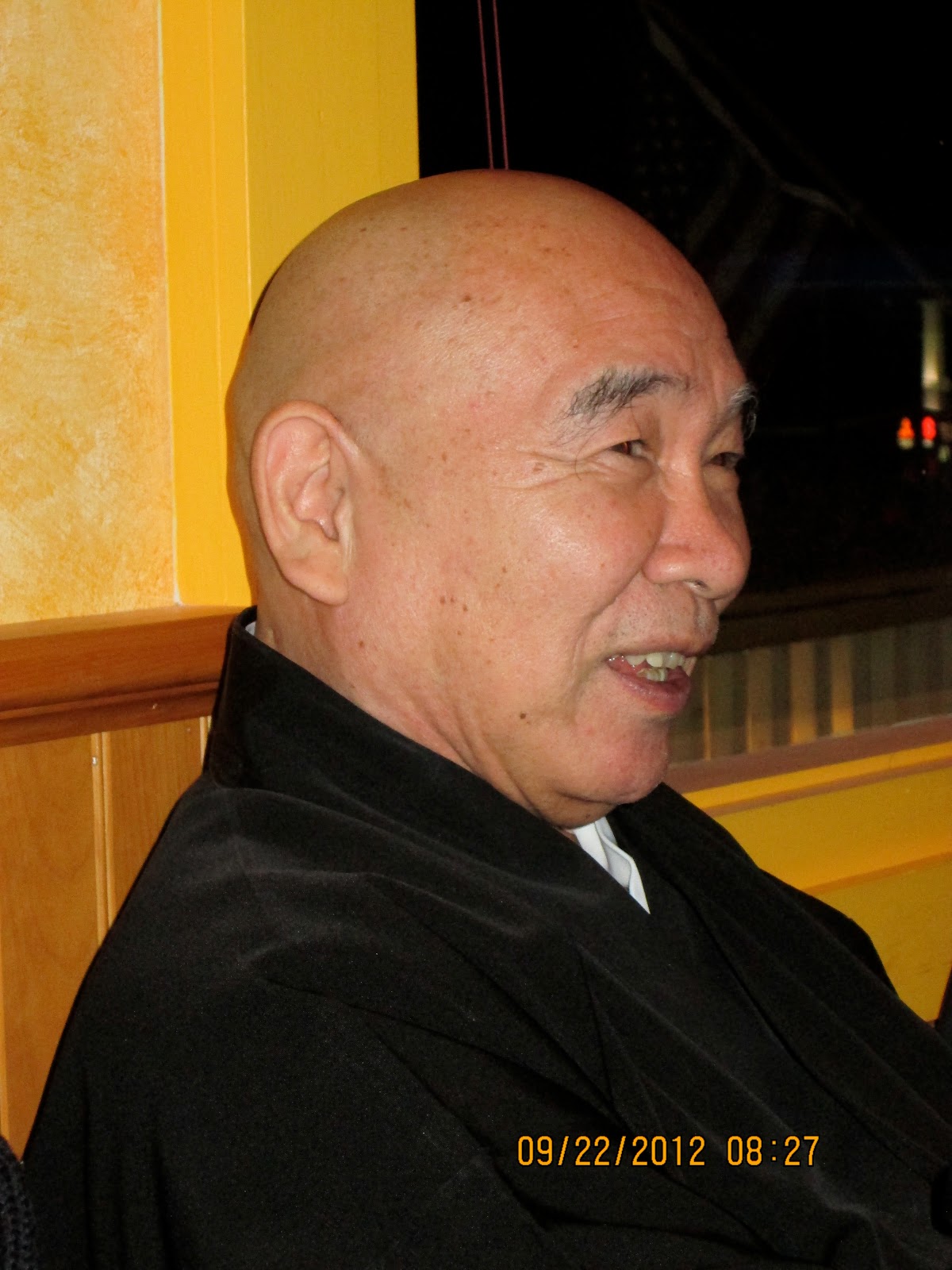
Ajari Jomyo Tanaka, September 2012


The Challenge of Shodo, #1


"Facing the paper and reaching for the brush I experience a calm, relaxed feeling.  My whole being is concentrated on the small square of paper and as I contemplate the possibilities of form, balance and rhythm open to me, the paper seems to grow in size.  I write one copy and then another and soon the brush has become an extension of my inner self.  The brush translates into black and white through the simple medium of a line, a form many artists cannot express even with a rainbow of colours on their palette.  Being totally engrossed in the potential and the problems of constructing the character, the sensation of time just slips away.  I write thirty or forty copies and my subconscious quietly ascends a crescendo of excitement as I near the goal.  Finally I have it.  A copy that is perfect in form and bursting with energy.  Each time I look at it I see that my feelings of the moment have been put down on paper for eternity.  This feeling communicates itself not only to me but to others as well.  The better the writing, the more understandable my expression.”

Christopher J. Earnshaw,
From his work, “SHO, Japanese Calligraphy”
(Earnshaw 1988, p. 1)


Wednesday, September 19, 2012

A sample of Ajari Jomyo Tanaka's Shodo

Ajari Tanaka arrived for his annual visit to Vermont just last Wednesday evening.  Besides conducting a retreat and a dharma name event, he has been producing some very bold and distinctive brush work.  Here is a sample:

"The heart is the great artist"
"Peaceful face, lovely speaking"
"Emptiness"
"maitri"


(These last two are circa 2001 or 2002, but Ajari Tanaka just put the seal stamp on them today so are included here.)


We are sure there will be more to come.  Enjoy and stay tuned...

Saturday, September 8, 2012

An unexpected visitor...

A number of years ago Ajari Tanaka arrived for his annual September visit much like he had done many times before.  But not long after his arrival he began to tell of a good friend, Tamagawa-san who had spent his adult life working as an engineer for a telecommunications firm.  This friend was unique in that his hobby was hand carving statues of Buddhas, Bodhisattvas and Dharma Protectors in the classic Japanese style.  Then to our surprise Ajari produced one of his friend's statues from inside a piece of carry-on luggage.  Piece by piece, each carefully bubble wrapped, Ajari removed the work of art.  After some unwrapping and cautious assembly, there sat a statue of Nyoirin Kannon (Cintamani Chakra Avalokitesvara), a six armed version of Kannon that holds an important place in the mandalas, symbolisms and practice of Shingon.  We were dumbfounded.

Since that time the statue has held the place of honor in our Burlington dojo.  This Nyoirin Kannon is our "honzon" or main image, the central figure of our dojo.  It sits in the center of our shrine installation surrounded by ritual implements, other sacred art and numerous offerings.  It has been the constant companion of our weekly group meditation for years.  As the time has passed, we have grown in our appreciation of its beauty and the "special something" it lends to our dojo.

A few weeks back, the couple who own the home where our Burlington dojo resides, both long-time students of Ajari Tanaka, began to receive letters and emails from Tamagawa-san suggesting he would be visiting "our temple" very soon.  We were not only surprised but dubious.  We had only heard of this person and had absolutely no previous contact.  Not quite sure what to think, we just waited.

As it turns out, Tamagawa-san showed up in Burlington last Thursday accompanied by his grand daughter who attends high school in western Canada.  It seems his visit to us was part of his visit to his grand daughter marking the beginning of her Junior year in high school.  Luckily our friends who live in Burlington had the day free as Tamagawa-san was looking for a full day of site seeing - Shelburne Museum, Vermont Teddy Bear Company, a Lake Champlain tour on a local ferry, a full slate.  Tamagawa-san also wished to attend our regular Thursday evening meditation practice.

That evening a group of us arrived at the typical time and met Tamagawa-san and his grand daughter.  With him he had a photo album of many of his works.  Some of us reviewed it with great interest.  He had carved dozens of beautiful pieces over the years, many of which are important symbols in Shingon - Fudo-myo, Jizo Bosatsu, Aizen-myo, Dainichi Nyorai, Daikoku-ten and many others.  All were beautiful and elegant in the classic Japanese style and Tamagaw-san told us each statue took about a year to complete.  Wow...

As warned Tamagawa-san attended our weekly mediation in which he both participated and took pictures of us.  Perhaps a bunch of Americans chanting the Heart Sutra in Japanese and sitting silently in meditation was too curious not to capture some proof.  It was very nice to have he and his grand daughter there and we finished our practice with the recitation of a mantra associated with our Nyoirin Kannon.

The night ended not long after our practice concluded as Tamagawa-san was tired from his big day and he needed to depart the very next day.  But before he left we were able to capture a picture of the artist with his creation.  Here is Tamagawa-san in our Burlington dojo:


Tamagawa-san's visit reminds us of something Ajari Tanaka will often hint at.  Ajari Tanaka always reiterates without ambiguity that our practice, if consistent and persistently done will bring a real happiness and relaxation into our lives.  But Ajari also suggest that our practice will bring wonderful things into our lives that we never quite imagined.  Experiences we would never have had and people we might otherwise have never met, enriching moments and events that surprise but are somehow meant to be.  Ajari will often say that visits like Tamagawa-san's show we have a strong connection to him, even though we did not know him previously.  Maybe practice sparks some magic in life.

Not long after Tanagawa-san's visit we received the following email, so thoughtful and touching that the story of his visit is incomplete without it:

After leaving from you, we went to Saltspring and Whistler at western Canada coast.  Then return to Japan without any trouble.  
At the time when we were in Burlington, we received your great favorable treatment.  Champlain Cruise, Shelburne Farms and Teddy Bear Company were much interested.  Your Shingon practice was also very impressive.  We should inform you much appreciation.  This travel will become my very good and impressive memory in my heart.
Mr. Tanaka will visit you in the next week, and will discuss with you future plan on your temple.  When completion of your new temple building, we would visit again to your temple with new Buddhist statue.  I hope to see you again.
Thank you.   .   

We were surprised to discover we will build a temple by next year, but maybe that's the next bit of unsuspected magic to come into our lives.  Despite that mystery, we too were filled with much appreciation and the memory of Tamagawa's visit will linger.